

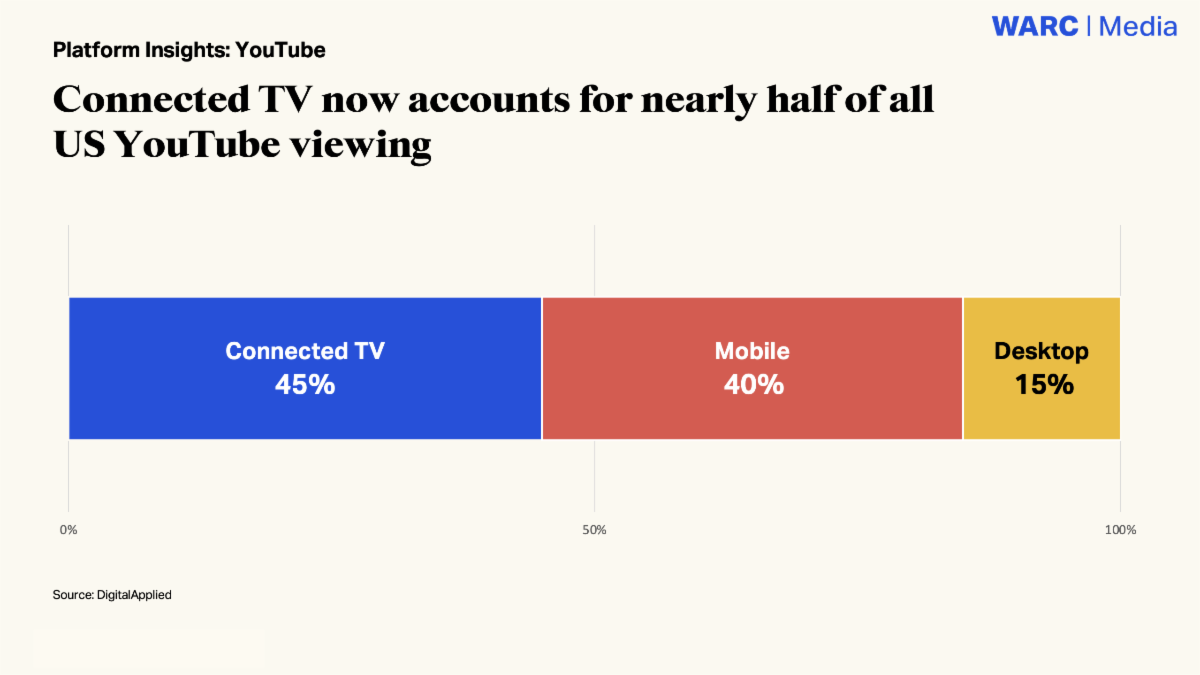
Mobile is no longer the only screen on which the battle for YouTube users’ attention is being fought. In the United States, nearly half of the platform’s total watch time already comes from connected TVs, where the average session lasts more than 45 minutes and content completion rates exceed 95%.
This move into the living room has brought YouTube closer to traditional television than any other digital platform. However, growth in audiences and content consumption has not yet translated into equally rapid advertising revenue growth.
According to the new WARC Media Platform Insights: YouTube report, the platform’s advertising revenue grew by 11.7% in 2025, reaching $40.4 billion. Total revenue, including YouTube Premium subscriptions, exceeded $60 billion for the first time.
The rate of growth is nevertheless gradually declining. After 14.7% in 2024 and 11.7% last year, WARC Media expects growth of 7% in 2026, bringing revenue to $43.2 billion, followed by 7.9% in 2027, when advertising revenue is expected to reach $46.6 billion.
The platform is therefore entering a more mature phase of development, in which it must compete for every additional share of marketing budgets with rivals offering clearer solutions to specific advertiser needs. TikTok is strengthening its position in social commerce and campaigns focused on direct sales, and at current growth rates, its advertising revenue could overtake YouTube by 2028.
A different kind of pressure is coming from Netflix. The development of its ad-supported tier is creating new competition for budgets aimed at large screens, premium video content and audiences previously dominated by television broadcasters. WARC Media estimates that Netflix could gain an advantage in attracting subscriber and advertiser investment over the next 18 months.
The Audience Is Not Only Growing, but Staying Longer
Nearly 2.6 billion people use YouTube every month, but the biggest change is not simply in the number of users. Average daily time spent on the platform increased from 48 minutes in 2024 to 58 minutes in 2025.
India is the largest individual market, with around 500 million users, ahead of the United States with 254 million. Indonesia follows with 151 million users and Brazil with 150 million. Data from Similarweb App Intelligence also shows that YouTube generates more total time spent than any other social or video platform.
Users aged between 25 and 34 make up the largest demographic group, accounting for 21.7%. They are followed by those aged 35 to 44 at 18.5%, while people over the age of 65 represent 9.5% of the audience.
However, Gen Z remains the most commercially important group. After watching an ad on YouTube Shorts, 51% of men and 43% of women from this generation made a purchase, increasingly turning short-form video into a sales channel rather than only an entertainment format.
Shorts Generates 200 Billion Views a Day
YouTube Shorts now generates more than 200 billion views a day, while in several major markets, including the United States, revenue per watch hour has already surpassed that of traditional in-stream formats. Results also vary by ad type: in-feed formats achieve click-through rates of between 1% and 3%, while non-skippable ads remain below 0.3% and are better suited to building brand awareness. Further growth will therefore also depend on advertisers’ willingness to adapt their ideas and production to short-form vertical video.
Trust among marketing professionals nevertheless remains strong. According to Kantar, YouTube has ranked as the most preferred and most trusted advertising platform for the third consecutive year, while it places behind Netflix in brand safety. Its offering is also expanding beyond music and entertainment: podcast viewing on TV screens increased by 70%, reaching more than 700 million hours per month, while the platform has also become the leading social source used by large language models, ahead of Reddit.
The platform is therefore growing and slowing down at the same time. Watch time, TV screens and Shorts are expanding its influence, but competitors are increasingly challenging parts of the advertising market in which YouTube had considerably more room for years.

