

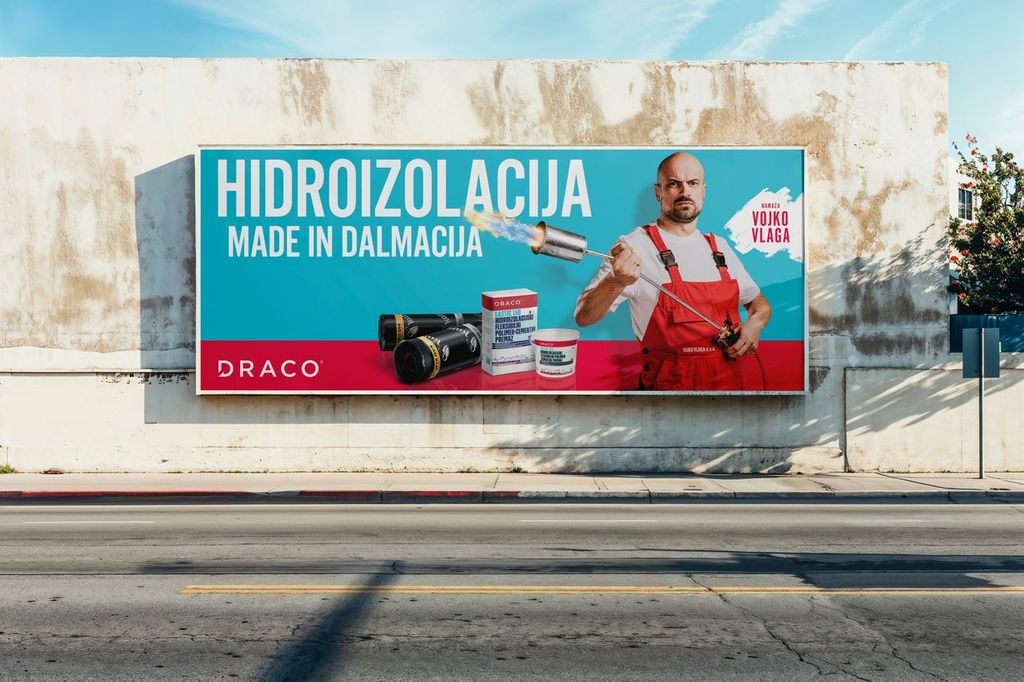
Photo: Domagoj Kunić i Ana Cindrić
At a time when audience attention is increasingly difficult to retain, and advertising often remains at the level of short-term reach, some brands are attempting to change the entry point of communication. Instead of the message, the focus shifts to a format that holds its own intrinsic value. The campaign “Vlaga” by the brand DRACO follows exactly this direction.
The project was developed as a music release that only subsequently reveals its commercial context. At its core is the character Vojko Vlaga, an alter ego through which the theme of waterproofing is translated into a narrative that belongs more to pop culture than to advertising. The song and video were released at the end of February 2026 on platforms such as Spotify and YouTube, where early reactions largely perceived them as authentic music content.
Such an approach implies a departure from the conventional “branding-first” model. Instead of building the message around the product, the project starts from the assumption that content must function independently and earn attention before the audience even connects the story with the brand. In practice, this means delayed branding and a subtle presence of the company in the early stages of distribution.
According to available data, the video surpassed a million views in a short period and became one of the fastest-growing pieces of content in the artist’s career to date, with significant organic reach and media presence. Audience and media reactions suggest that the project was initially interpreted as a commentary on the times, rather than as an advertising activation.
The concept of the campaign relies on a broader social context. At a time when much of the public discourse focuses on the impact of artificial intelligence and the potential replaceability of certain professions, craft-based jobs are once again gaining visibility and value. Within this framework, the figure of the waterproofing specialist is used as a symbol of stability and tangible work, giving the project an additional layer of meaning beyond the product category itself.
The collaboration with Vojko V was positioned as an authorial partnership rather than a traditional ambassador engagement. This model was crucial for the content to retain credibility and avoid the perception of “an ad pretending to be a song.” At the same time, for the brand, this means accepting greater uncertainty in terms of narrative control and the pace of its reveal.
The campaign “Vlaga” thus opens a question that is increasingly present in contemporary marketing. How far a brand can go in stepping away from direct communication in favor of content that functions independently of it. In this case, the answer comes through a project that entered the public space first as a cultural artifact, and only then as advertising.

