

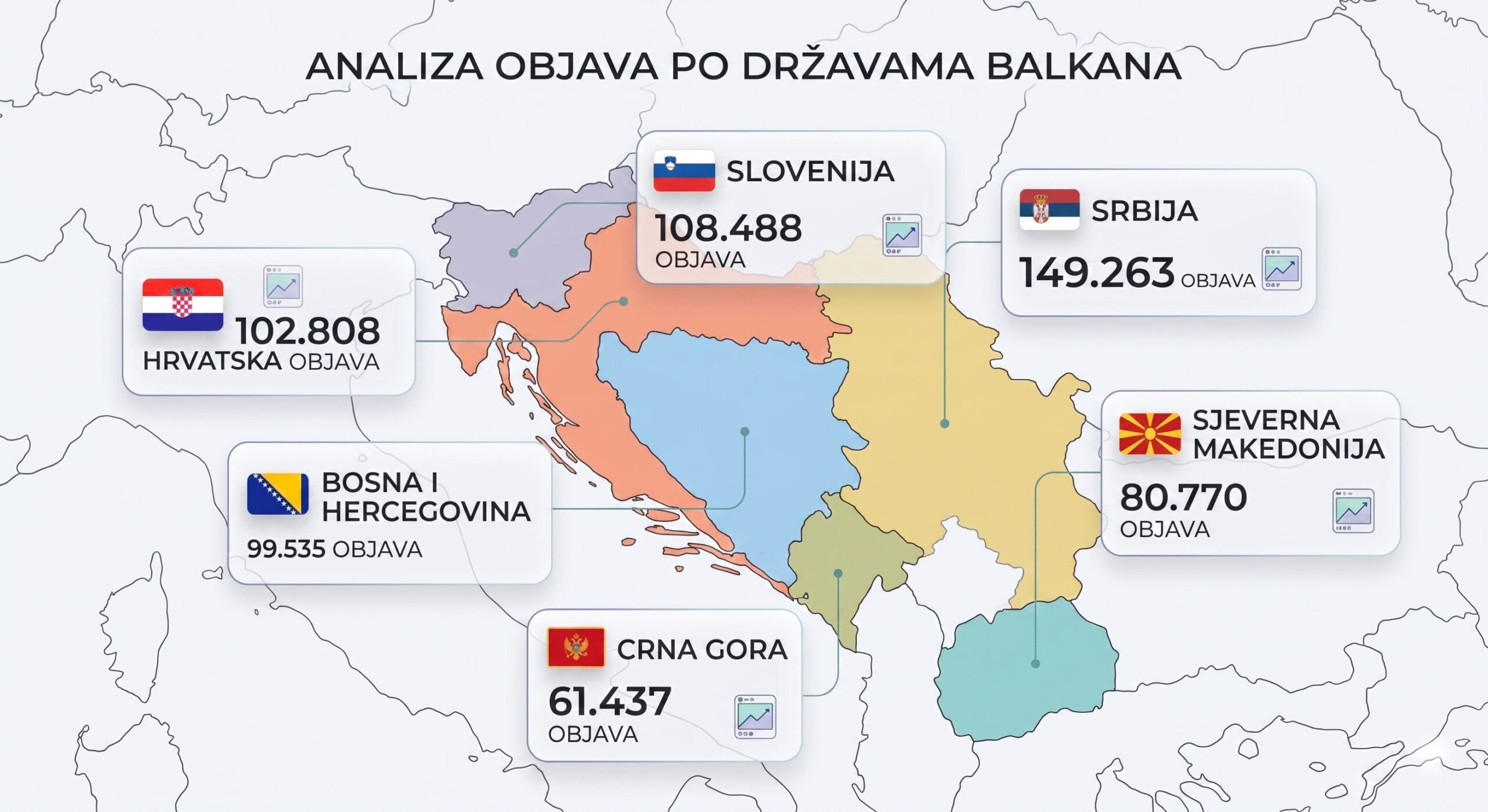
Data on mutual media reporting in the countries of the former Yugoslavia, collected by the media monitoring and analysis companies Press Clipping Maribor, Press Clipping Zagreb, Press Clipping North Macedonia, Press Clipping Banja Luka and Ninamedia Kliping Novi Sad in the period from 1 January 2026 to 31 March 2026, offer an exclusive insight into how regional socio-political and cultural processes are reflected in public discourse across the region. Systematic monitoring of media publicity does not merely show the volume of information flows, but also sheds light on the mechanisms and processes through which media systems co-shape political culture, geostrategic trends, self-identification and the dynamics of popular culture. The media do not act merely as transmitters of news; they are active creators of social reality. Through the selection or creation of content, they can decisively influence social cohesion and the (in)stability of interstate relations.
Systematic media monitoring (media monitoring) is a key analytical tool for detecting social trends, as it does not measure only the mere presence of information, but reveals deeper geopolitical and communication patterns. The sample database, obtained through precise media monitoring, comprises a total of 602,301 media reports*, distributed across six countries. If we analyze only the raw volume of production, we get the following ranking: Serbia is in first place with 149,263 reports, while Montenegro is in last place with 61,437 reports. Between them, the countries follow in descending order: Slovenia ranks second with 108,488 reports, Croatia is third with 102,808, Bosnia and Herzegovina fourth with 99,535, and North Macedonia fifth with a total of 80,770 reports. The ranking shows a steady decline in the number of reports from the first to the last country.
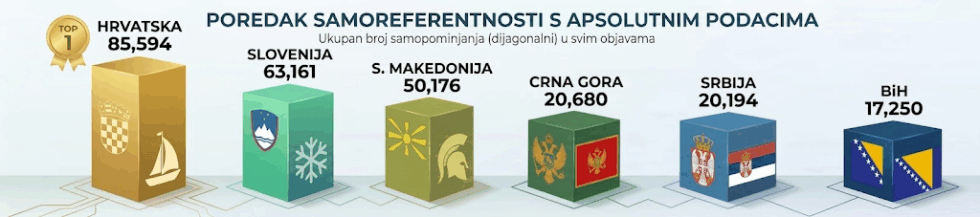
The results of this monitoring of six countries show that the degree of regional integration, informational closure and self-referentiality differs surprisingly across the countries. The data analysis that follows provides a statistical overview of these differences, with a pronounced asymmetry of attention standing out as the key finding: while the Croatian media space shows a high degree of informational self-sufficiency, public discourse in Serbia and Bosnia and Herzegovina is to a large extent marked by a focus on developments in neighboring countries.

Description of the empirical dataset on the scale
* The analysis is based on a structured matrix of media appearances, obtained through systematic and continuous monitoring of leading news media (online portals, print media and television programs) in six former Yugoslav countries. The dataset is organized so that the columns represent the source (the media space of the country generating the reports), while the rows represent the subject of reporting (the country mentioned in those reports). This database serves as an empirical starting point for determining the interconnectedness of the public sphere, measuring the degree of media closure and examining asymmetry in regional communication flows.
Regional information hegemon and influence on neighboring countries
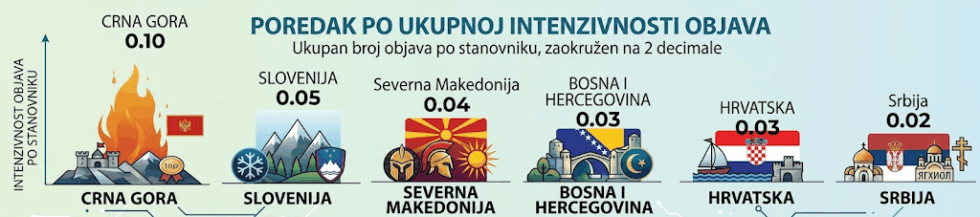
To ensure a higher degree of comparability, we divided the frequency of appearances by the population of each country. Serbia, despite having the lowest per-capita index (0.02), confirms its role as the region’s absolute information influencer. The key to understanding this dynamic does not lie in the row reflecting its own activity, but in how much its neighbors write about it. Serbia is, in fact, a massive exporter of topics: Montenegro’s media generate as many as 31,334 reports about Serbia (more than about Montenegro itself!), while Bosnia and Herzegovina generates 27,656. This points to a deep asymmetry in the regional media space; political, cultural and social topics from Serbia dictate the daily information cycle in Sarajevo and Podgorica, with Belgrade remaining the main political and media hub of the Western Balkans.
Montenegrin hypersensitivity and entrapment in the regional orbit
With the highest relative coefficient (0.10), it emerges as the most media-vulnerable or most reactive space. Given that it is a small country with only 626,000 inhabitants, this exceptionally high density of reports does not indicate a high level of development, but rather extreme saturation with external influences. The Montenegrin media space is literally trapped in the orbit of its neighbors, as the number of mentions of other countries, primarily Serbia with 31,334 reports and Bosnia and Herzegovina with 11,204, dramatically exceeds the number of reports about Montenegro itself (20,680). In relative terms, Montenegro thus acts as an information sponge, absorbing regional tensions and political narratives far beyond what its demographic characteristics would suggest.
As we know, a deeper understanding of society and culture repeatedly requires critical self-reflection on our shared values and habits. Although this overview represents an important step in the analysis of collective communication processes, the question of self-admiration remains open. In the next article, we will therefore take a closer look at a specific phenomenon, namely “media national egocentrism per capita.” We will explore the background and reasons why Montenegro and Slovenia convincingly lead this unique ranking.
To be continued.
Mag. Janez Kne
Head of Analysis, Press Clipping d.o.o.

