

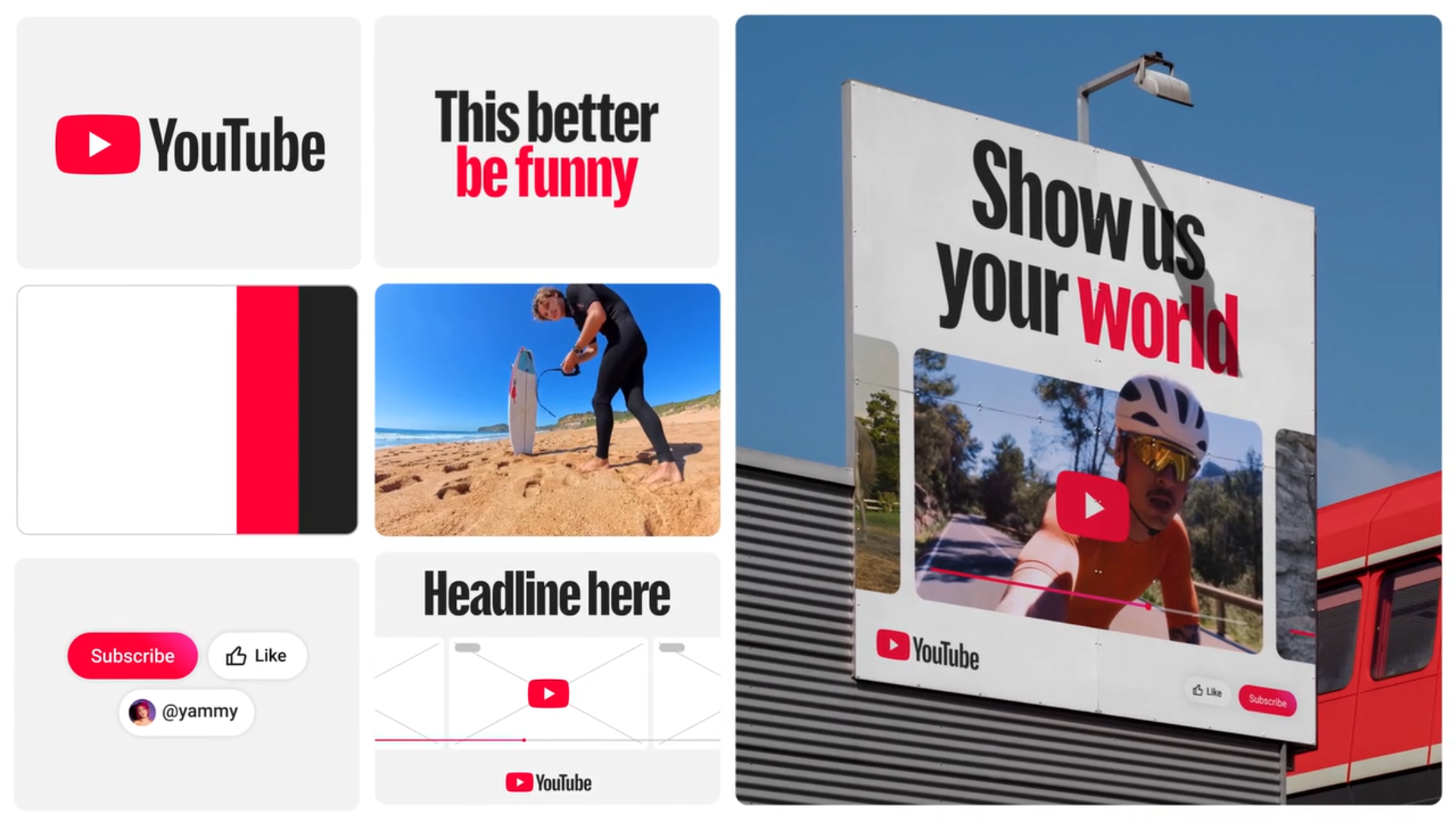
Marking its 20th anniversary, YouTube has introduced a new global visual identity alongside its first dedicated motion system, developed in-house by YouTube Creative Studio. The update spans Shorts, Music, TV, Premium and Kids and is designed to bring greater cohesion to a family of sub-brands that had gradually diverged in design and tone. Guided by the concept of feeling “alive,” the refreshed system gives YouTube’s ecosystem a more unified and expressive look, reinforcing the platform’s ongoing shift from a functional utility to a fully realised entertainment brand. The new identity is now rolling out globally and is being promoted through out-of-home advertising.
“When a brand lives everywhere, it risks feeling like nowhere,” said Kieran Mistry, who led the project in a freelancing capacity for YouTube Creative Studio, in a press statement. “Our task wasn’t to reinvent YouTube, but to design a system that connects its many sides, unified but never uniform.”
Rather than reinventing the brand from the ground up, YouTube’s new identity builds on cues that are already familiar to its audience. Core colours, interface references and long-standing platform language have been retained, then refined to feel more flexible and expressive across marketing, product touchpoints and cultural moments.
The aim was to reconnect a brand ecosystem that had slowly fragmented as different teams and products developed their own visual and tonal approaches. Instead of forcing uniformity, the new system is designed to feel cohesive while still allowing room for variation and context.
Motion sits at the centre of the rebrand, marking YouTube’s first formal motion identity. Details such as subtle camera shake are intended to mirror the natural movement of creator content, lending the brand a sense of responsiveness grounded in how people actually experience the platform. Typography and illustration also play a key role. A new display typeface, developed with Sharp Type, draws on the geometry of the YouTube logo and supports nine global scripts, while illustrations created with Gesture Systems balance bold simplicity with a playful edge, giving the brand the flexibility to adapt across regions and formats without losing recognisability.
In announcing the refresh, YouTube highlighted its intention to move beyond a static visual language, reinforcing its positioning as a fully fledged entertainment destination rather than simply a functional platform. The shift comes as the wider social media landscape continues to evolve rapidly, shaped by the rise of generative artificial intelligence, a key strategic focus for Google, as well as the growing integration of e-commerce features that turn video into a shoppable medium.
At the same time, YouTube is expanding deeper into connected TV and streaming, as more viewers consume the service via living room screens, bringing it into more direct competition with traditional film and TV platforms such as Netflix. The Google-owned company has also continued to invest heavily in short-form video through Shorts, its TikTok-style format, which is gaining momentum with both advertisers and audiences. Reflecting that growth, YouTube advertising revenue rose 15% year over year to $10.26 billion in the third quarter ended September 30.

