

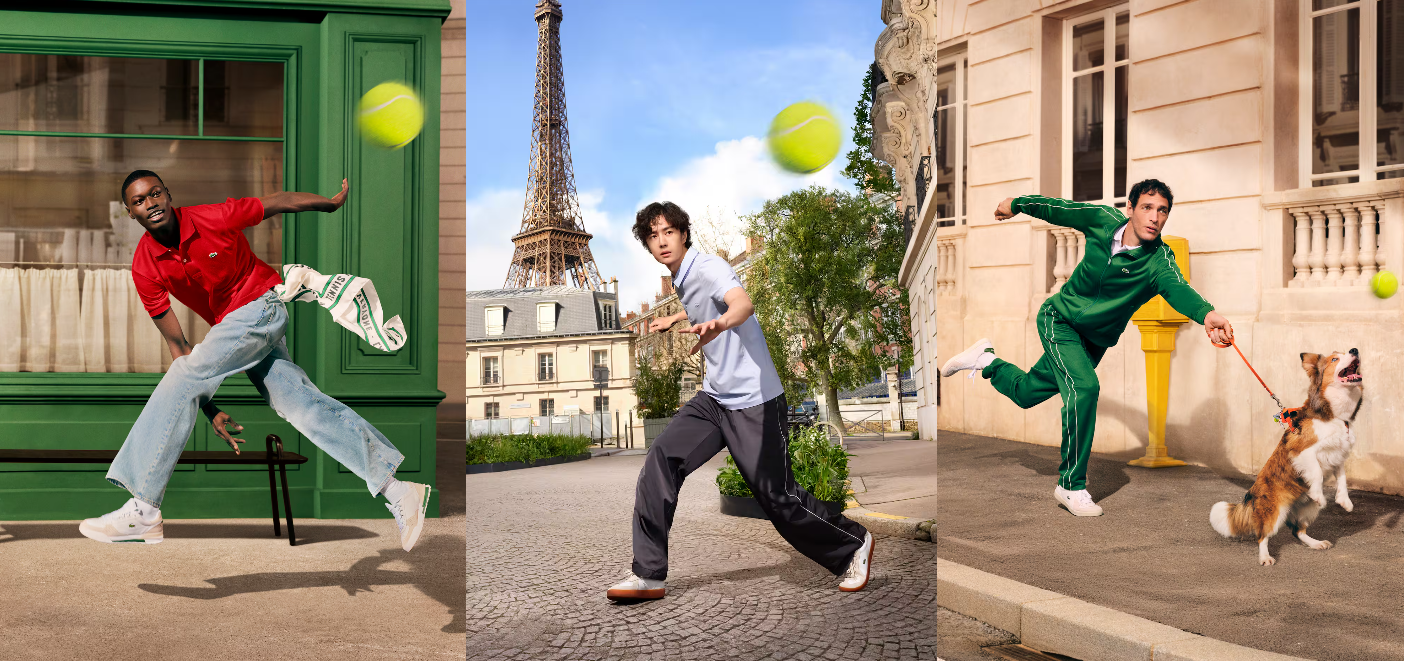
At a time when premium and luxury brands are constantly balancing the need for modernization with the preservation of recognizability, Lacoste’s new global campaign Life is a Beautiful Sport confirms how strategic brand evolution today depends on the ability to reinterpret heritage as a contemporary competitive advantage.
Through this campaign, the French fashion house is not simply introducing a new communications platform, but also a carefully structured refresh of its overall visual identity, drawing from its archival history to further solidify its position at the intersection of sport, fashion, and lifestyle culture.
Directed by Fredrik Bond, the campaign revives the original platform launched in 2014 while preserving its central idea that sport extends beyond performance to become a way of life, attitude, and cultural expression. Through a narrative set within an urban Parisian context, Lacoste uses rhythm, movement, and everyday gestures to present sport as an extension of identity rather than merely competition.
The campaign gains additional symbolic weight through the presence of Novak Djokovic, further reinforcing the brand’s decades-long relationship with tennis and its 55-year partnership with Roland Garros. This connection goes beyond sponsorship visibility, functioning instead as a key element of Lacoste’s brand architecture that continuously links performance, elegance, and cultural relevance.
The print campaign, photographed by Angelo Pennetta, places iconic pieces such as the polo shirt, pleated skirt, Lenglen bag, and tracksuits into everyday urban scenarios, further dissolving the boundaries between sporting heritage and contemporary premium lifestyle.
Alongside the campaign, Lacoste is also introducing a refreshed visual identity built around subtle yet strategically significant refinements of its core brand assets. The updated typography reintroduces serif characteristics from historical logo versions, drawing inspiration from founder René Lacoste’s handwriting, while the iconic crocodile is brought closer to the original illustration created by Robert George.
Rather than pursuing complete transformation, the brand adopts an evolutionary model focused on refining existing assets, an approach increasingly becoming dominant among global heritage companies seeking to protect established brand equity while simultaneously signaling modernity.
The more visible red tongue of the crocodile, the return to the original shade of green, and the symbol’s more flexible application all point to a strategy that does not replace recognizable codes, but instead optimizes them for a new market environment.
According to CEO Éric Vallat, the goal is not to redefine the brand, but to reinforce its authenticity at a time when consumers increasingly seek meaning, credibility, and cultural value.
This philosophy positions Lacoste as a strong example of an increasingly important market model in which brands do not drive growth through constant reinvention, but through consistent identity management, ownership of symbolic assets, and the integration of product, communication, and cultural context.
The campaign will gain further global visibility during this year’s Roland Garros, where Lacoste operates not merely as a tournament partner, but as an integral part of its identity, using its sporting roots as a long-term platform for differentiation.
For the communications industry, Life is a Beautiful Sport offers a relevant example of how modern rebranding does not have to mean disruption, but can instead rely on carefully managing existing heritage through the modernization of systems, design, and storytelling.
In a market where authenticity is increasingly proving to be a rare asset, Lacoste clearly demonstrates that returning to one’s roots can be one of the most powerful tools for future growth.

