

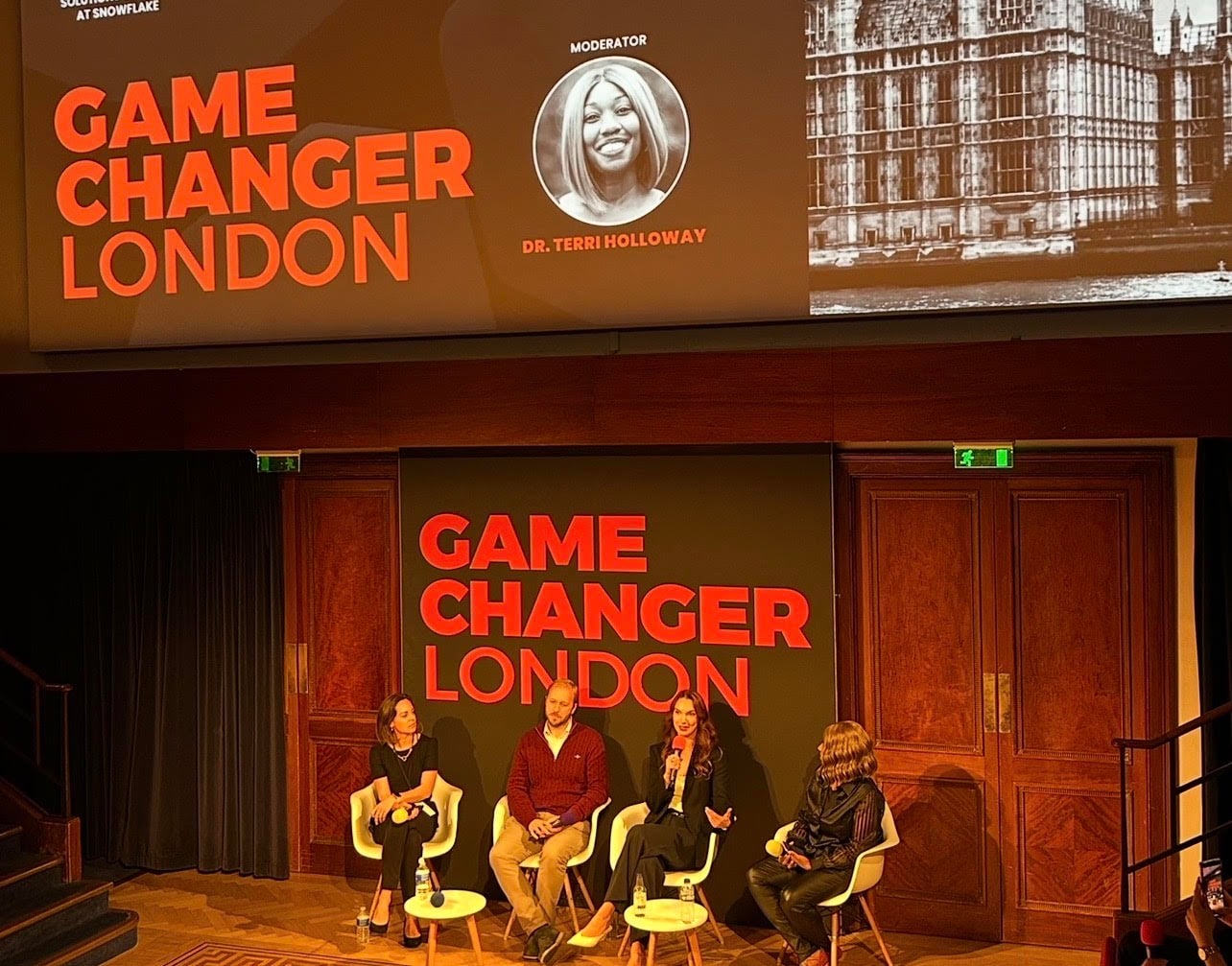
Game Changer London 2.0 opened a question that is increasingly defining business, media, and society: who actually controls decision-making systems today?
Held at the Royal Institution of Great Britain in London, the conference gathered more than 350 experts, researchers, investors, and technology leaders who, through a series of panels, analyzed how artificial intelligence is already changing the way economies, media, capital, and human behavior function.
Unlike many AI conferences that still remain focused on predictions and technological hype, the second edition of Game Changer London was much more focused on the consequences AI is already producing in real time – particularly in the areas of trust, decision-making, and behavioral psychology.
The central theme of the conference was the idea that artificial intelligence is no longer just a tool that helps people, but an infrastructure through which information, attention, market decisions, and social relationships are now filtered.
The conference was opened by Dr. Vanja Ljevar, who through the topic “It’s a Matter of Trust” positioned trust as a key element of future AI systems.
As highlighted during the opening part of the program, in an environment where algorithms are increasingly participating in business, financial, and media decisions, trust is no longer an emotional category, but an operational condition for how systems function.
One of the more significant panels, “The Future of Impact Investing”, raised the question of how the logic of investing is changing at a moment when AI systems are beginning to optimize not only profit, but also social impact. The topic was discussed by Joseph Tenzin Oliver and Samir Beg Ceric, moderated by Shirley Choo.
Particular attention was also drawn by the discussion “Customer Relevance at Scale: AI, Behaviour & Retail Personalisation”, realized in partnership with Recommend, in which Laura Belchier, Ivan Andabak, and Ekaterina Doubinina analyzed how thin the line between personalization and behavioral manipulation has become today.
The topic of media and audience attention occupied an important place within the program through the panel “The Future of Media: AI, Trust & Psychology of Attention”. Patrick Fagan, Lea Karam, and Meropi Kylika, moderated by Dr. Terri Holloway, spoke about how AI no longer affects only content distribution, but is increasingly shaping emotional reactions and audience attention patterns more directly.
The conference did not remain focused only on optimistic technology development scenarios. The panel “The Illusion of Readiness: Why AI Transformation Is Harder Than It Looks”, organized in collaboration with SmartCat.io, raised the question of how prepared companies truly are for AI transformation, despite the increasingly aggressive market narrative around “AI readiness”.
Through a discussion featuring James Pearce, Michal Karnibad, Alexander May, and Filip Baturan, it was emphasized that a large number of organizations still lack the infrastructure, processes, and work culture required for the real integration of AI systems.
One of the more interesting segments of the program also focused on the luxury industry. The panel “Luxury in the Age of AI: Desire, Identity & Psychology of Value”, realized in partnership with Latenta, analyzed how algorithms are increasingly influencing perceptions of value, identity, and desire within the premium market.
The conference closed with the panel “Building in the Age of AI: Startups, Behaviour & the New Rules of Innovation”, focused on a new startup logic in which speed is no longer the main competitive advantage, but rather the ability to understand user behavior in real time.
The second edition of Game Changer London demonstrated how today’s AI discussion is moving away from technology itself and increasingly entering the territory of trust economics, the psychology of attention, and the social architecture of decision-making.
The key question is no longer whether AI will change the way companies, media, and markets function. The question is who designs the systems on which that new reality will be built – and how much real control people within them still have.

