

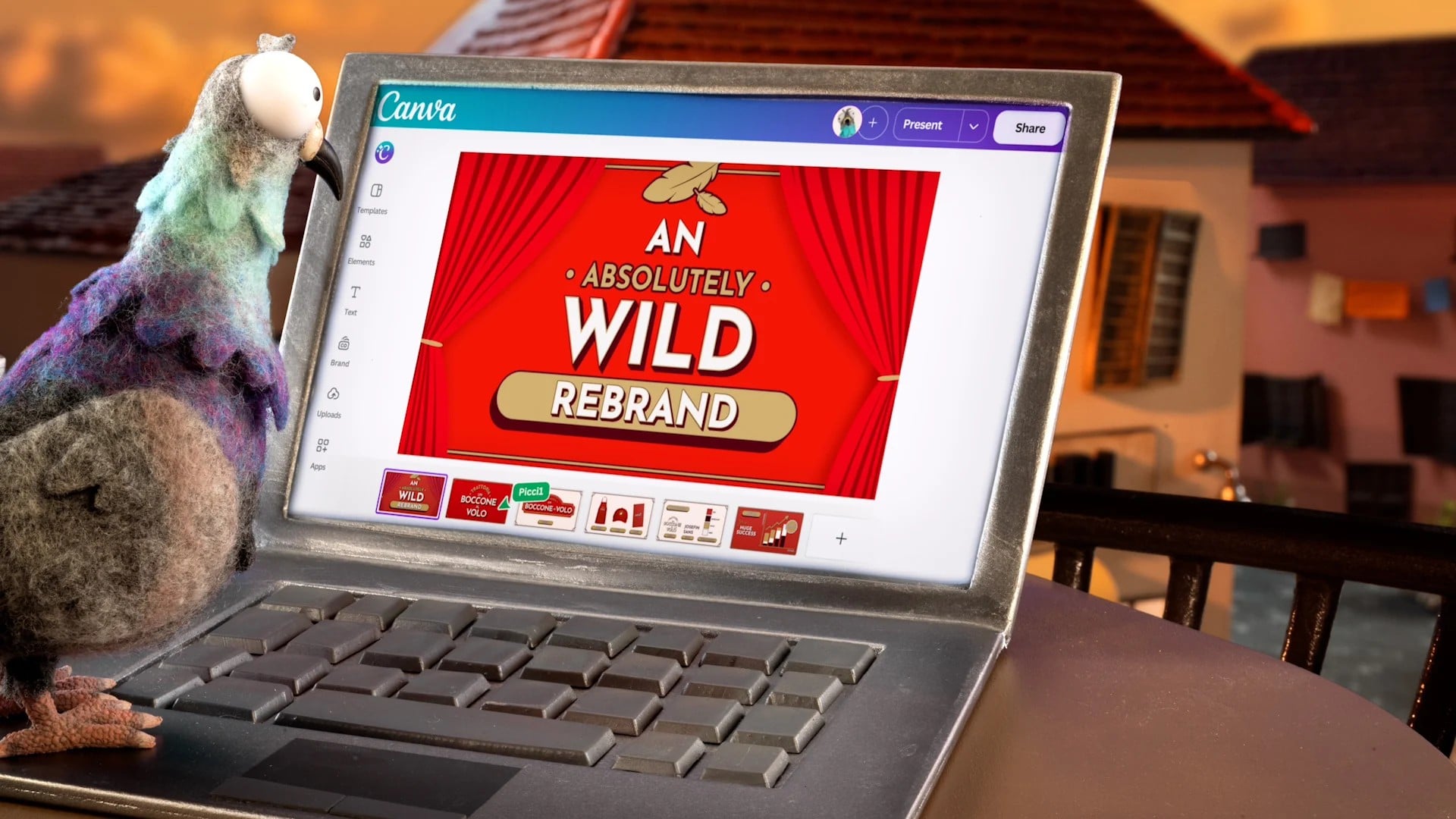
Photo source: Canva
As digital design tools become increasingly sophisticated and artificial intelligence takes over a growing share of creative processes, Canva has chosen to build its latest campaign on a completely different logic. Instead of a technological showcase or a demonstration of AI capabilities, it places craftsmanship, imperfection and stop-motion animation at the centre of its communication.
The new campaign, Wild Design, created for the Italian market, represents Canva’s first major brand campaign in the country and arrives at a time when the market for creative tools is being rapidly transformed by generative artificial intelligence.
The campaign was created by DUDE Milano, produced by A+C Studios, and directed by Dan Richards, an animator who previously worked at Aardman Studios.
At the centre of the story is a pigeon named Picci1 who becomes the unexpected creative director of a local trattoria struggling with a lack of customers and an outdated visual identity. Using Canva tools, Picci1 develops a new logo, promotional materials and communication solutions that bring customers back to the restaurant while simultaneously increasing the number of crumbs available to the local pigeon community.
View this post on Instagram
Although it is a simple and humorous story, the campaign actually opens up a much broader discussion. At a time when design is often perceived as a complex discipline reserved for professionals, Wild Design seeks to demonstrate that creative tools can also be accessible to users without formal design experience.
Particular attention is drawn to the production approach. Every element of the film was physically crafted, from the characters and props to the tablecloths and food. The puppets, sets and details were all handmade, with a pronounced textile aesthetic that gives the campaign a warmth and tactility rarely seen in today’s digitally dominated communications.
The campaign will run across television, connected TV platforms, social media, digital channels, radio, as well as OOH and DOOH formats throughout Italy. In addition to the main 30-second film, three shorter films focused on specific platform features are planned, alongside additional radio content and outdoor advertising inspired by the character of Picci1.
Interestingly, the campaign arrives at a moment when Canva, much like its competitor Adobe, is heavily investing in the development of AI-powered features within its platform. As a result, Wild Design also raises broader questions about how technology companies today balance the automation of creative processes with the promotion of traditional craftsmanship.
Regardless of this contrast, the campaign clearly illustrates one of the dominant trends shaping today’s creative industry. The more powerful digital tools become, the more handcrafted work, imperfection and physical production emerge as powerful communication symbols.

