

Consumers will soon no longer have to open ten pages themselves, compare tariffs, check prices and select the best offer. Part of that work will be taken over by an AI agent, a system that understands a given goal, plans the necessary steps and can act autonomously on behalf of the user.
According to new research by WARC and PHD, such systems will be involved in global consumer spending worth $3.35 trillion by 2030. This will represent 3.8 percent of total spending, almost three times this year’s 1.3 percent, or $944 billion.
The report From abundance to agents: How the delegation of choice is transforming marketing starts from a problem that digital marketing has long tried to solve by creating even more choice. Consumers today have more content, products and offers than they can review, so the value of AI agents will not lie in adding new options, but in removing them.
Most decisions will still remain in human hands. Agents will, however, increasingly determine which products enter the shortlist, which offers are rejected and what is ultimately purchased. For brands, this means that attracting consumer attention will no longer be enough. They will also have to be understandable to systems that read prices, availability, specifications, reviews and purchase conditions.
The United States will be the largest market, with $1.1 trillion in agent-mediated spending in 2030, accounting for 31.9 percent of the global total. China will follow with $505.8 billion, while the United Kingdom will reach $131.2 billion. The ten markets analysed will together account for 67.9 percent of total spending.
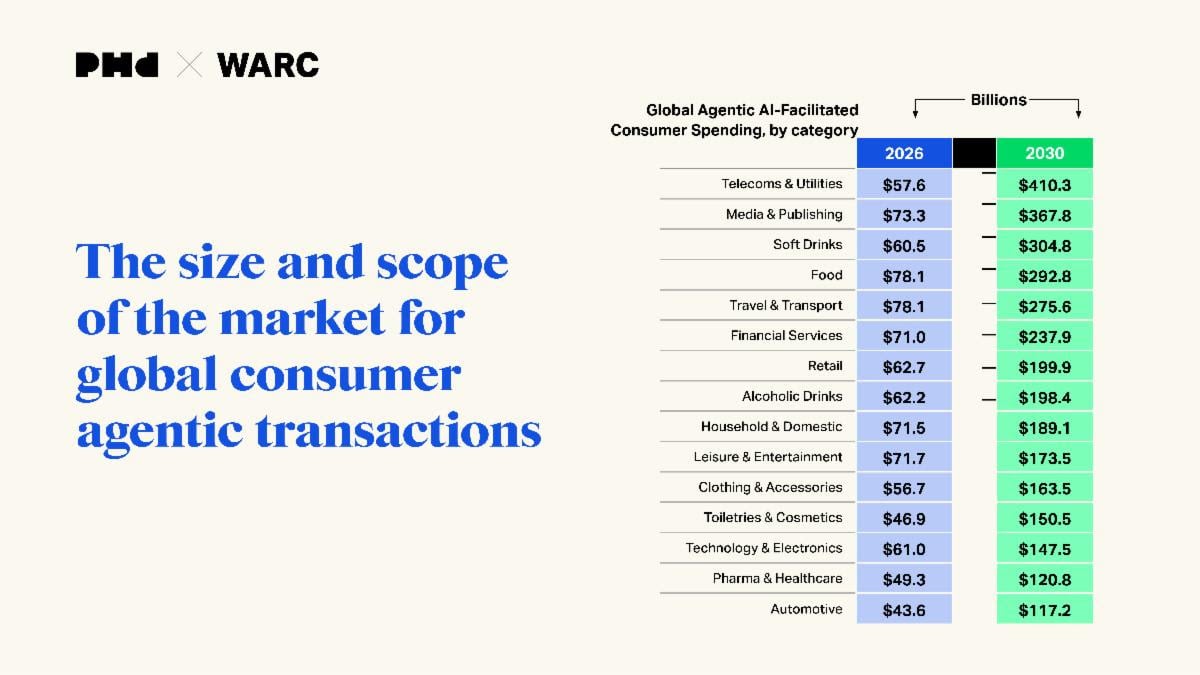
The fastest change is expected in categories where choice is complex but data is easy to compare. Telecommunications and utilities are leading this development. Agent-mediated spending in this category will rise from $57.6 billion in 2026 to $410.3 billion in 2030, representing growth of 611.9 percent.
Financial services will remain too sensitive for decisions to be fully delegated to technology, but users will increasingly rely on agents to compare and understand offers. The value of such spending is expected to reach $237.9 billion.
Travel and transport will already be the largest individual category in 2026, at $78.1 billion, and will grow to $275.6 billion by 2030. Route planning and the comparison of flights, hotels and prices make this area particularly suitable for delegation.
The research also introduces the Four Modes Framework, a model that distinguishes between Agent to Agent, Agent to Consumer, Brand to Consumer and Consumer to Consumer relationships. It shows that agents will not affect all purchases equally.
In routine categories such as food, soft drinks, media and subscriptions, systems will more frequently take over repeat orders and recommendations. In automobiles, electronics, healthcare and pharmaceuticals, human judgement, trust and privacy will retain a greater role. Cosmetics, fashion and other categories shaped by creators and recommendations from other people will also change more slowly.
Marketing therefore faces a dual task. A brand must still be recognisable and relevant to people, but its data must also be structured, accessible and clear enough for an AI agent to understand, compare and recommend it.

