

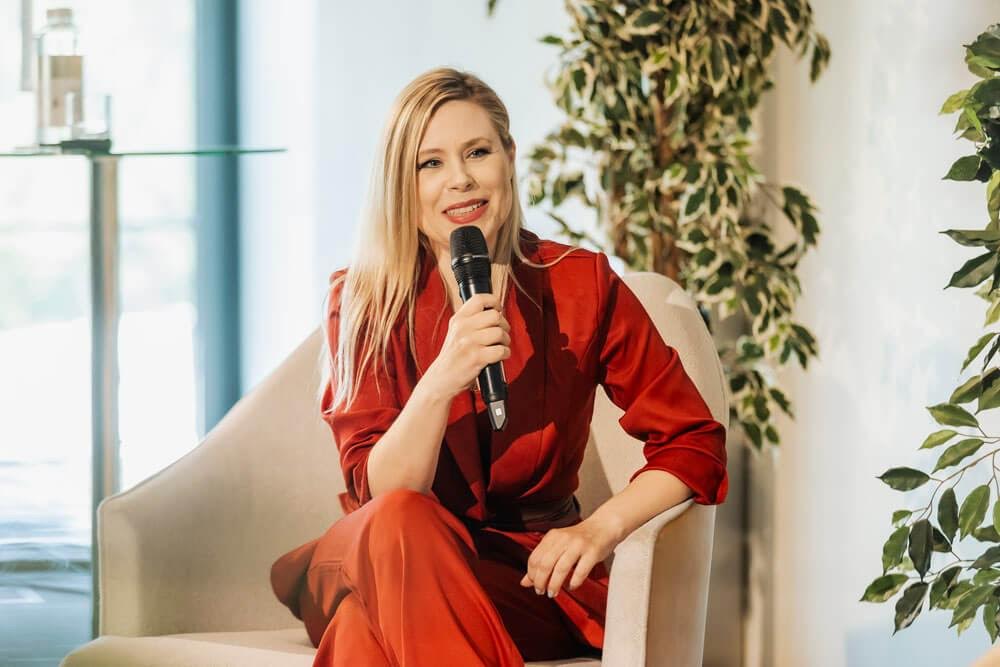
For Media Marketing, interview conducted by Lenja Faraguna, in the interview series: “Marketers of the Future”
In an industry that increasingly tries to standardise and measure even what is inherently immeasurable, empathy easily becomes just another word in the sequence – something that is declaratively advocated, but rarely consistently lived.
The conversation with Ines Markovčič shifts the focus precisely from that formal level to what cannot be planned: the feeling of belonging, the authenticity of relationships, and the energy that determines how people truly work together.
Empathy here is not treated as a tool or a leadership technique, but as a personal and collective responsibility that is recognised in everyday decisions, communication, and the willingness to admit mistakes. It is precisely in that difference between declaration and practice that the key to long-term trust lies – within teams, but also towards the brand that emerges from them.
How important a role do empathy and emotional agility play in building a culture that attracts and retains talent?
Huge. Essential. But it must not feel artificial, like something manufactured. Just so it exists. Because it has to. Because it is recommended. It must be established as organically, naturally, and relaxed as possible. I think that is the hardest part and that precisely because of that organisations often fail to build culture, fail to attract enough talent, or fail to retain them. I am convinced that the good old law of romance always wins. If someone truly feels good in a company, if it brings them joy, a relaxed feeling and professional self-actualisation, they will hardly or less likely leave for somewhere else. Even the factor of money will not convince them or push them into temptation. However, people are different. For some, that feeling of good culture and strong togetherness matters more, while others do not mind the environment they work in, as long as the salary is good and there are benefits.
Is empathy encouraged in your environment, or are leaders expected more to show logic and decisiveness than an empathetic relationship with people?
In the environments I work in, open communication, exchange of thoughts and opinions are encouraged. I personally encourage, nurture and advocate that, regardless of the final outcome, whether results or decisions. Sometimes the results are better or worse, as are decisions that are not always to everyone’s liking. What matters is that collaborators, regardless of that, have a sense of acceptance and motivation to continue working. The art is to criticise well and at the same time preserve that feeling of acceptance. It must be reciprocal. It is also good for collaborators to give the leader a sense that they too will be accepted if they make a mistake. For that to happen, a leader must know how to admit a mistake, apologise, and authentically show vulnerability and responsibility. The worst is when everything ends in a toxic atmosphere where everyone feels threatened. Then a different approach is needed. Unfortunately, not everything is always ideal.
How do you personally or within your organisation perceive the connection between leader empathy and business success? Do you have an example where it made a concrete difference?
Everything I have taken on in life based on empathy, a sense for others, and my own intuition has delivered results. Whenever I followed the path of rational logic and calculation, it did not end well. I learned to listen to my empathetic side. In the medium and long term, it has always proven to be the right path. There are several examples. I would highlight Super Znamka. I was advised to collaborate with many people who did not align with the values I follow. I stayed consistent with my values and vision, and then everything started to open up. We attracted people who share the same values. We all support each other, and everyone fulfils themselves in their role without rivalry. It is also important that roles are clearly defined and accepted.
How does the Slovenian business context today understand and use empathy as a leadership skill?
Over time, I can say that things are improving. As a society, we are waking up, including in the business context. There is more talk about mental health and it is no longer a taboo. However, empathy is still not a standard or expected leadership skill; it is more of an example and a recommendation.
How did you start talking about “soft” skills such as emotional culture, psychological safety, and empathy in your company?
We did not talk about it through terms. We simply live it. We share emotional states with each other. When you enter an environment, you can feel how people function together. The focus is on how someone acts in certain situations and how to further develop that approach. One should not dwell on weaknesses, but look for ways to reach the desired result through them. It is very demanding and there are no universal solutions. One must know how to choose battles. Even weaknesses can be an opportunity. It is ironic that we strive for psychological safety in a society that is increasingly individualistic. Everyone wants to be a leader, and we value other roles too little. Learning from others is a privilege.
How do you develop or support empathetic leaders? Is it built or sought?
I support leaders who already have developed empathy and intuition. It is quickly recognised. It is not always sought. Some people prefer a different leadership style. An empathetic leader understands different employee needs and adapts. You cannot expect an introvert to become an extrovert, but that does not mean they cannot be a valuable part of the team. An empathetic leader knows how to activate the right people at the right moment.
What does an organisation without emotional agility look like?
Such organisations feel cold and inauthentic. It is felt immediately, already upon entering the space. Everything can be perfectly arranged, but the energy of people is not good. I am not talking about productivity, but about the energy among people.
Is empathy a matter of process, person, or values? How is it introduced into a company?
First, it is a matter of the person and their values, only then of process. The process is a journey. It is introduced into a company through constant testing of approaches, keeping what works and discarding what does not. It is a living process without a clear formula.
Have you seen an example where a brand improved externally due to internal changes?
Yes. Such brands progress enormously. Sometimes the arrival of one person makes a big difference. People are different, but a brand that understands this aspect achieves better results.
How do you recognise a leader who can remain empathetic without reacting quickly or judging?
By patience and humility. Such a person puts their ego aside and listens carefully to people. They know how to manage different interests and drive results. They know when to react, set boundaries, and maintain balance within the team.
Do you see a difference between leaders who develop these skills and those who do not?
Absolutely. It is visible in communication and employee reactions, but also in relationships among colleagues.
If empathy were a KPI and had ROI, how would you measure it?
By people’s smiles. By their feeling. It is hard to measure it mathematically. It is visible in engagement and behaviour in crisis situations. That is when you see whether a team holds together or falls apart. Empathy is reflected in joint problem-solving and a healthy reaction to mistakes.

