

Dani komunikacija have long ceased to be just a place where the best work is showcased, international speakers are heard, and the market’s creative energy is affirmed. They are also a rare moment in which the communications industry simultaneously reveals its ambition, differences, pressures, and its own internal dilemmas.
Under one roof gather creative, digital, media, PR, and specialized agencies, each with their own interests, business models, and views on where the industry is truly heading. That is precisely why Dani komunikacija are not merely a festival program, but the most visible public expression of a profession changing faster than it can sometimes explain itself.
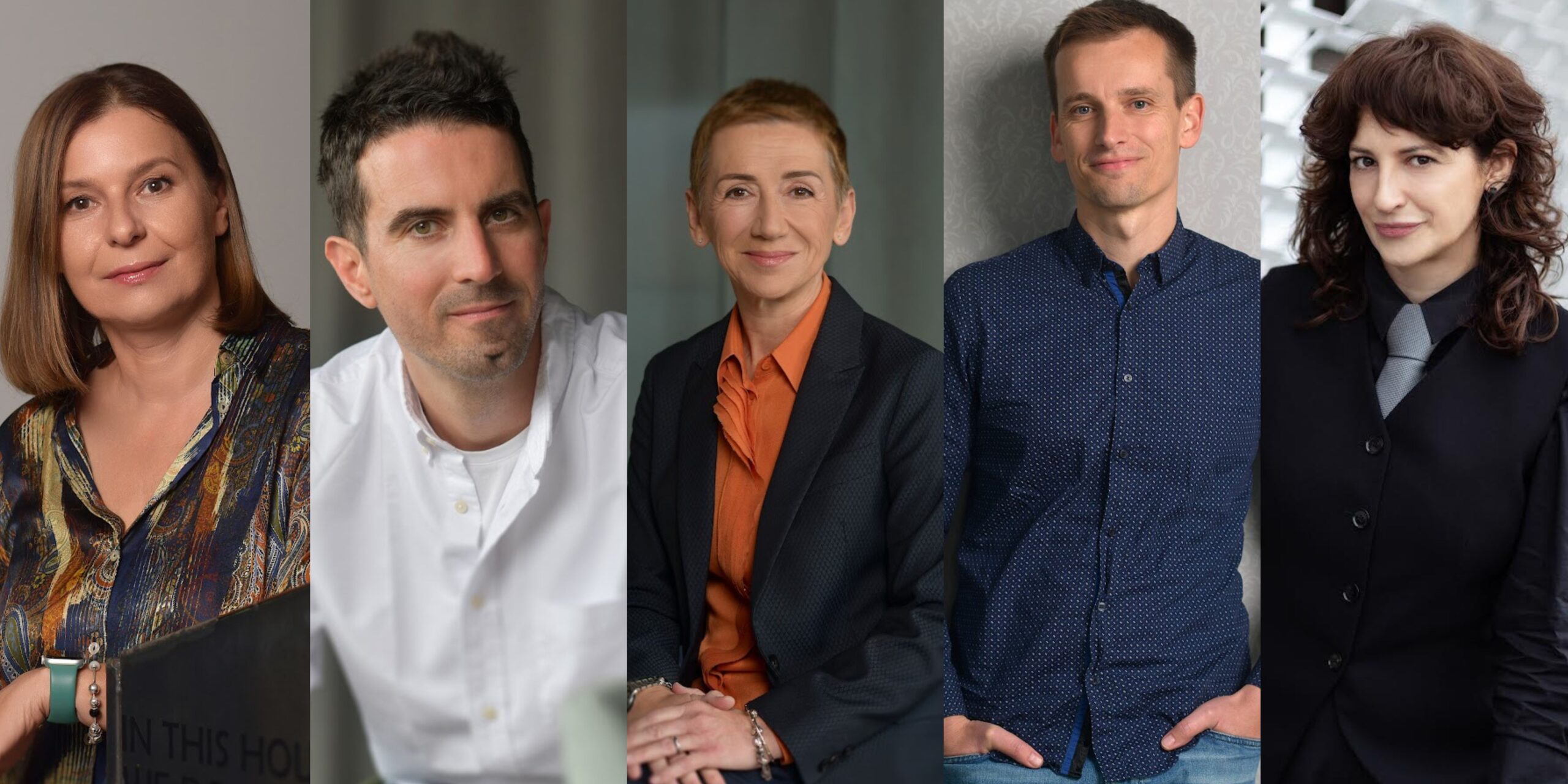
In conversation with members of the Board of the Croatian Association of Communications Agencies (HURA) – Jelena Fiškuš, Kristina Laco, Rajna Cuculić, Mario Frančešević, and Marko Šesnić – we open the questions behind the festival image: to what extent do Dani komunikacija truly strengthen the industry’s reputation beyond its own circle, where do creative ambitions diverge from real budgets, why is digital no longer simply about clicks and reach, and what does the festival, through its visual, spatial, and content identity, say about how the industry today understands creativity.
Because if Dani komunikacija are the industry’s most visible moment, then it is important to ask not only what the industry wants to present, but what its festival actually reveals about its real priorities, relationships, and transformations.
Jelena Fiškuš
DK brings together agencies with different profiles, interests, and market positions under one roof every year. What do those three days actually reveal about the tensions within the industry that remain politely unspoken the rest of the year?
Dani komunikacija actually accelerate and amplify conversations we are already having throughout the year. I would not call them tensions, but rather normal differences within an industry that is changing rapidly, within an association that truly brings together highly diverse agency profiles, and topics that we address rather than sweep under the rug. Every type of agency has its own specific areas of interest and ways of operating, but the things we work on together transcend those differences and serve the greater good of the profession as a whole. It is always good to voice even the things we disagree on, because everything we articulate out loud usually leads to better understanding, and often to the realization that some things can be done more intelligently.
Kristina Laco
HURA systematically researches how the public perceives the communications industry, while DK is its most visible public moment. Does the festival truly strengthen the profession’s reputation, or is the industry primarily speaking to itself, and what would need to change for the answer not to be the latter?
DK today is a strong and clearly profiled festival whose reach has long surpassed the narrow agency circle, and even the wider communications industry itself. Thanks to continuity, relevant speakers, and topics that often transcend the boundaries of the profession, it undoubtedly contributes to the visibility and reputation of the entire industry. Of course, strong promotion, which is our core business, as well as quality media partnerships, significantly support this. However, the profession’s reputation is certainly not built in three festival days, but in what remains after them, in the people who carry good ideas and high standards forward through their everyday work. For the reputation of the profession, it is important that DK remains a place of inspiration and encouragement for the industry to become even more open and present in the broader social dialogue, which I believe this year’s edition will also achieve.
Rajna Cuculić
HURA publishes media spending data, while DK simultaneously celebrates the industry’s creative peak. Where do these two images intersect, where do they diverge, and what do media budgets actually tell us about the direction the industry is heading, as opposed to what the festival program suggests?
I believe these two images intersect in one crucial thing – both show where the industry wants to go. But they diverge in where the industry actually is.
Media spending data is very concrete and often “unembellished” – it shows where clients are truly investing money, under what pressures they make decisions, and how willing they are to take risks. The reality is that a large portion of budgets still goes into channels and tactics that deliver short-term, measurable results. This tells us that the industry is under increasing pressure from performance, efficiency, and the need to justify every cent.
On the other hand, the festival program, including Dani komunikacija, represents the industry’s aspiration – the creative peak, the best ideas, bold breakthroughs. It reflects what we would like to be: strategically relevant partners who use creativity to build long-term brand value.
The gap between these two worlds may be greater today than ever before. While festivals celebrate breakthroughs, the market largely rewards safety. While we talk about integrated ideas, in practice we often see fragmented budgets and a focus on individual channels.
What is particularly interesting to me is that media budgets do not actually negate creativity – they reveal how rare it is in real business environments. And that is where I see room for progress: how to reconnect these two worlds so that creativity does not remain an exception rewarded at festivals, but becomes a standard that is systematically funded.
Because ultimately, the direction of the industry will be defined neither solely by numbers nor solely by awards – but by our ability to bring those two into the same sentence.
Mario Frančešević
DK have existed long enough that they can be used to measure how much the industry has truly changed. Digital marketing has undergone almost complete transformation during that time. What does the festival still not understand well enough about the digital industry today, and whose responsibility is that?
What may be harder to notice from the outside is that top-tier digital marketing no longer simply means budget optimization, creative execution, and tactical solutions on global networks, but rather the building of one’s own infrastructure: from ownership of first-party data to the application of AI that ensures companies’ long-term independence and builds their own value.
I believe we still do not communicate clearly enough that a large portion of those present at DK have long ceased to be “traditional” agencies and increasingly function as technological and business partners.
As long as we continue packaging our own successes to the public primarily through the language of clicks, impressions, and reach, the festival will rightfully expect that narrative. Perhaps all of us together should begin communicating more loudly about the value of infrastructure and data ownership, rather than merely dependence on someone else’s platforms?
Marko Šesnić
DK are not only a program, but also a mirror of the industry that creates them. When you look at how the festival is built – visually, spatially, and in content – what does it say about how the Croatian communications industry sees creativity: as risk or as well-packaged consensus?
DK is, in my opinion, the most visible and exposed communicator of our entire industry, and that is precisely where its importance lies. If you observe it exclusively through its visual and spatial dimensions, you might mistakenly conclude that it is a “well-packaged consensus,” as you put it in the question. Anyone who attends festivals knows that DK, in terms of production and organization, not only keeps pace with many of the world’s leading festivals, but is often far ahead of them. Fortunately for our entire industry, DK has spoiled us and represents a standard that grows year after year, sending a message to the broader public of a serious industry that is continuously evolving. When we dig deeper into the content itself and review the speaker lineup, you will see top-tier experts from the widest range of fields, but what is particularly interesting to me this year are the panels, whose number has exploded because the topics were submitted by the members themselves. That segment is full of intriguing and provocative themes which, in my opinion, are an excellent indicator that the industry is constantly questioning itself and has no fear of uncomfortable topics.

