

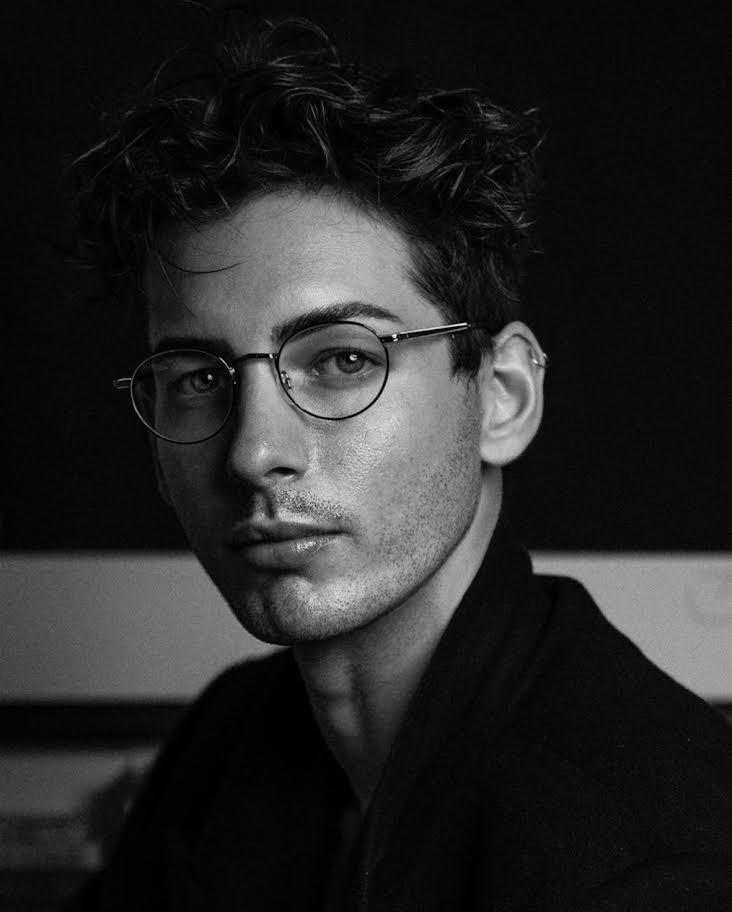
Damon Baker has redefined what it means to capture emotion through a lens. A photographer, director, and storyteller who splits his time between the United Kingdom and the United States, Baker’s work goes beyond “celebrity”- he manages to reveal the fragile, human side of icons like Celine Dion, Taylor Swift, Damiano David, and Nicole Kidman.
At just 17, he left home to chase his dream in New York, eventually signing with one of the world’s leading artist management agencies. Since then, his striking visual style has earned him global recognition and a devoted following online, where he often pairs his images with personal reflections on art and mental health.
Recently, Baker has decided to pursue a new creative path. Through his recently launched DB PRODUCTIONS, he is expanding into film, preparing for his directorial debut Ways of Loving . His mission remains clear: to bring truth, vulnerability, and authenticity into a visual world that often hides behind perfection.
Ahead of his SEMPL conference appearance and his next career chapter, we spoke with Damon about authenticity in the digital age, the emotional truth behind his art, storytelling and his upcoming steps.
Today, everyone talks about “authenticity,” but it often feels like just another marketing tool. How do you define authenticity online?
Hello, thank you for giving me your time and space to talk. I appreciate that. Okay, so it’s interesting that the question is framed as ‘authenticity online’… I’m not sure we are really at a point of understanding what that looks like. If we think about the root of authenticity, then it is being true to yourself, in the moment, whether that be through expression, growth, beliefs, ideology, creativity or just thoughts in general. Not adapting them to fit a construct or to benefit yourself outside of your own truth. Authenticity changes constantly because we change. It’s important to be open to debate and to learn from others to then experience your own authenticity. To translate that online, well, the internet, social media in general feels curated, now, we see it used as a tool to earn money. I personally worry about the amount of sexual exposure that we see. People in their formative years, making decisions from the fantasy of easy finance. I never judge, but if there was a deep sense of authenticity online, I don’t think there would be such a big surge of certain formulated identities, and sexual exposure is a big formula now. Authenticity can be used as a marketing tool of course, just as anything can within capitalism. But for me, and my authenticity, I don’t go as far as thinking in this way about how to curate myself or my art. I simply express how I feel, who I am, in the moment. However, someone receives that through the channel of the internet, is for them to determine its originality. I know my authenticity, that’s all that is important for me. And because I create from authenticity, I believe it can only be true within my body of art and language.
Audiences today have direct access to artists – through comments, messages, constant interaction. Does that closeness change the way you think about creating and sharing your work?
For me, it only changes in the circumstance that I get to see other artists blossom and be part of their journeys, even with a simple recognition from one human to another. A plead to never stop creating. As we never should stop. The most beautiful gift I have ever received in my life is to see multitudes of people, of all ages, create their art within my pictures, not copy them, but bring them to life, through their art. There was always this term when I started that copying someone or recreating their art is bad, is negative. I think it is the most pride I feel, to know something that I have created, has reached another artist.
Is there any particular project that made you realise how your work can connect people?
I would hope that all of my art in it’s unique way has reached and connected with another person in some type of way. Negative or Positive. But most importantly, it connected me to myself, which therefore connected me to people, and their art, their voice.
After years of digital storytelling, you’re now entering a new project – and a new medium, we might say. You’re entering the film industry with your upcoming directorial debut Ways of Loving. How much do you see this step as an evolution of your artistic expression, and how much as a completely new challenge?
I don’t see my filmmaking necessarily as a step. I feel it. A camera has always guided me through my external and internal being. Filmmaking and writing allows me to extend my voice, my emotions, my experiences… further. There have been many moments where I needed to see something, to understand, to feel less alone. It was hard for me to find that within the cinema space. I always knew I was a storyteller, I just know it would be my becoming, when the time was right. And finally, that time is now. The challenge is beautiful, because with my photography, I would have the thought, the vision created inside my mind, then I would bring it to life with my muse, then we would share a moment together within that creativity… then it is released into the world and I have to let it go. I’ve always been okay with this. Filming and being in the bubble of the world of characters who have always been in my mind, brought to life through my talented friends, living in that world, well, the challenge was leaving it. I seldom cry, which is ironic for an emotional person. I believe I cry through my art. However, leaving filming Ways of Loving, I cried. It was the time I realized what true heartbreak is. Thus, it shall live on in the way it is meant to and hopefully be there for the people in a way it is and was for me.
When you move from a still image to a moving one, from photography to film, what do you gain and what do you risk losing in the storytelling process?
I gain a community of incredible artists who are so passionate and talented in their art. From cinematography, set design, producing, acting, styling, makeup, hair, script rewrites. Working closely all together. Being open to developments within the world I once sat at home at my typewriter and put on paper. How can I believe that I deserve this? To be around so many that inspire me and motivate me. There is no risk in creating. There is no fear. I believe I only gain, because I create and I’m open. I don’t believe my creativity is the only or the strongest. I am completely welcome and grateful to work beside my fellow artists.
You believe authenticity is often missing from cinema today. What do you think caused that gap – and how do you plan to bring it back through your work?
It’s interesting to me because authentic stories in cinema are classified as independent storymaking. Isn’t that odd? Human stories are independent. Yes, the stories themselves are independent, but within the cinema space, independent cinema is not wholly supported as let’s say a fantasy or out of this realm movie production. Entertainment of course is crucial, people are and should leave their lives for a moment and be indulged within entertainment. Not everything has to be of purpose. That would be draining. However, this gap, well, I can only see it as financial formulas. Entertainment makes money. That formula is old, it’s dying. I think we can all see that. People, I hope, and believe, want to see the truth. Want to feel themselves within characters and arcs. Because we are complex. Not everything is a happy ending. Most things usually aren’t. And for a while, we didn’t want to look in the mirror, gosh, I mean, how frightening? To see all of my ‘what I’ve convinced myself are flaws’… spotlighted? No thank
you. But that isn’t what our core wants and it certainly is exactly what our core needs. Stories for us. By us.
If you could reshape the future of digital storytelling, what would you want it to look like? What do you hope it will evolve into?
Everything we discussed today. If we simplify it… Human Authenticity. No rights, no wrongs. Life. It’s messy. It’s complex. It’s fragmented.
Let’s not turn our sights from that. Let’s explore it.

