

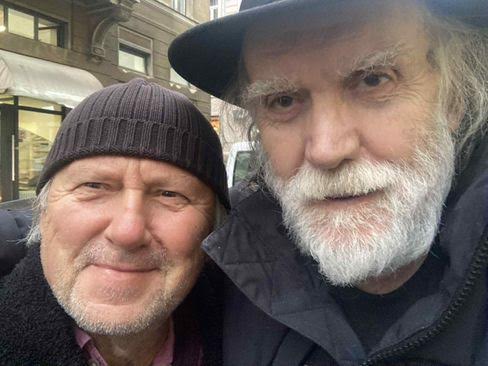
Author: Ekrem Dupanović
These days, the media are full of stories, sounds, and images about the Sarajevo tram carrying the people of Sarajevo for a full 140 years. During those fourteen decades, one theatrical performance took place inside a tram, featuring two actors: Zijah Sokolović and Josip Pejaković.
A little over fifty years ago, I spent a great deal of time with Dubravko Bibanović, Safet Plakalo, Zijah Sokolović, and Josip Pejaković. Zike and Josip attended the Drama Studio at the Small Theatre, today’s Kamerni Teatar 55. In the evenings, we would sit in the theatre foyer, chatting idly over Mujo’s rakija. Mujo was the host at the Small Theatre—he ran the bar and had the best rakija.
As students of the Drama Studio, Zike and Conja (Josip Pejaković) were given roles in theatre productions with which they were mostly dissatisfied. Most often these were roles of court jesters or something similar, while the two of them felt they deserved more serious roles in which they could demonstrate their full acting talent and knowledge.
One evening Biban, who was already seriously preparing to study theatre directing (after finishing philosophy in Sarajevo, he also completed directing studies in Belgrade), suggested that we organize a theatrical performance in a tram, with Zike and Conja as the only actors.
“There’s an excellent text – The Songs of Maldoror – written by Count de Lautréamont. A very serious text. We’ll set up sound in the tram, the two of you will stand at the back and recite the text, people will come in and out and take part in a theatrical performance. We’ll rename the text Maldoror’s Tram.”
The agreement was reached in a minute.
I took it upon myself to secure a tram. I thought, I’ll dial the phone number of Izet Buševac, director of GRAS, and that will be that. But it wasn’t so. For a month I called repeatedly, several times a day, and always got the same answer from the secretaries: the director was busy. I think the hair on her head stood on end whenever she heard my voice.
After a month, we’re sitting in the evening over rakija. Zike and Conja have learned the text, Biban is nearing the end of his directing work, and I still don’t have a tram, without which there can be no performance. I look at my watch and realize I can still make it to the railway station. I rush out of the theatre, stop the first taxi, and catch a train to Belgrade.
In the morning, upon arriving in Belgrade, I take a taxi and tell the driver to take me to the Hotel “Jugoslavija,” which had opened a few months earlier. It was the first de luxe hotel in Yugoslavia, capitalism entering our socialist country through the front door. By a twist of fate (more on that later), I had already stayed in that hotel for a full month and knew that there were no direct phones in the rooms: you dial the switchboard and give the number you need. The operator would then dial the number and say, “Good morning, this is Hotel Jugoslavija, our guest would like to speak with you…” There was hardly anyone who wouldn’t answer immediately. A call from a guest at Hotel Jugoslavija was no small matter.
After checking in, I took a room and immediately called the switchboard, giving them the number of the director of GRAS in Sarajevo. Izet Buševac answered right away. I told him what I needed; he accepted everything, promised a tram, and invited me for coffee the next day at 11 a.m. I hung up, went down to the reception desk, paid the bill, took a taxi to the railway station, and caught the late-morning train back to Sarajevo.
Buševac was so impressed by “a guest of Hotel Jugoslavija” that, at GRAS’s expense, he engaged three fire trucks to wash Marijin Dvor, from where the tram would depart, because the pavement was covered in mud from fallen autumn leaves—it had been raining.
How did I end up at the Hotel “Jugoslavija”?
A few months before Maldoror’s Tram, I began volunteering at the Sarajevo bureau of Belgrade-based Novosti, which had a practice of sending exceptionally talented correspondents to the Belgrade newsroom for a month-long internship. Since I met the criteria according to the editors’ assessment, they sent me to Belgrade. Their obligation was to cover all my expenses, including hotel accommodation.
Sreten Petrović, head of the Sarajevo bureau, tasked me with taking care of some important matters with Miki Stamenković, the editor-in-chief.
Upon arriving in Belgrade, I reported to Milojka Mlađenović, head of the correspondents’ service. The Belgrade Technical Fair was taking place at the time, which meant that there wasn’t a free hotel room anywhere in the city or within a 50-kilometer radius—no matter how much you were willing to pay. That’s why Milojka told me:
“Listen, I can see you’re capable. You’ll find yourself a hotel—just bring us the bill after a month and we’ll pay it.”
I left Novosti, got into a taxi, and told the driver to take me to the Hotel “Jugoslavija.”
I had read that the hotel had opened and that the prices were such that no one but foreigners stayed there. Of course, there were vacant rooms. I settled in comfortably.
The next morning, Milojka asked me if I’d found a hotel. I said I had. She didn’t ask which one, and I didn’t say. When, after a month, I brought her the bill from Hotel “Jugoslavija,” she nearly had a stroke.
“Did you really have to stay at the Jugoslavija?”
“You didn’t say anything except that I should find myself a hotel room. And I did.”

