

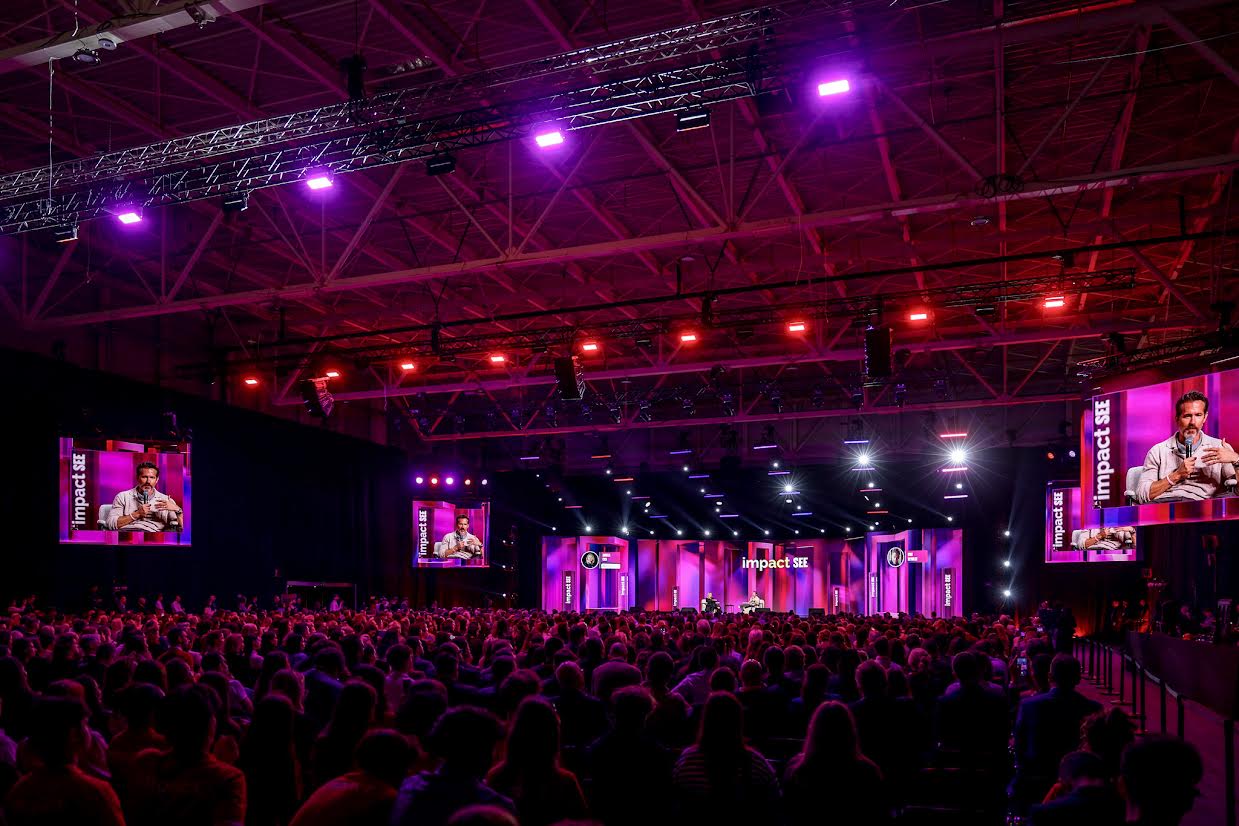
Mistakes as part of the creative process, attention as a resource companies compete for every day, and a European problem that is not a lack of talent but the ability to turn it into growth. Across the three stages of the Impact SEE’26 presented by Mastercard conference, held on 29 and 30 September in Bucharest, discussions on business, technology and the economy often returned to the same question: what today separates an idea, company or economy that has potential from one that manages to make use of it.
Ryan Reynolds spoke about this from his experience as an entrepreneur. Alongside his acting career, he built his business experience through ventures such as Maximum Effort, Aviation Gin and Mint Mobile, in which humour and an understanding of cultural context became part of the business model of communication.
Speaking about how he recognises an idea that is ready to be brought to life, Reynolds particularly reflected on the pressure of perfection.
“You can’t manage perfection. Perfection is a disease that, I think, afflicts almost everything in society today. You have to be willing to be bad at something in order to get good at it. I really believe that. I’m constantly trying to teach my kids this: make mistakes. Mistakes are fertiliser. The question isn’t whether you’ve made a mistake in life, but how you use that mistake,” said Reynolds.
When attention becomes a business resource
The other side of technological development was opened through the question of how much the constant battle for attention costs us. Stanford psychiatrist and author of Dopamine Nation Anna Lembke spoke about the way digital devices and reward systems create the need to constantly check for new content.
In a discussion with business leaders, the topic expanded to the responsibility of companies whose products and services try to attract and retain users’ attention for as long as possible. For Lembke, the solution is not even more stimulation, but precisely the ability to step away from it and return to direct experience and relationships with other people.
Europe has talent. The question is whether it can finance its growth
In the economic part of the conference, the focus shifted to European competitiveness. Economist and former dean of INSEAD Ilian Mihov warned that Europe’s problem is not a lack of human capital, but the way innovation is organised and financed.
“There is growth potential in Central and Eastern Europe, but we need to make use of it. Personally, I believe Europe has the highest concentration of human capital per square kilometre. Europe’s challenge is not a lack of human capital, but the way innovation is organised. Innovation needs financing, but European markets are fragmented and small. We need to deepen our financial markets so that Europe can finance its own investments,” said Mihov.
Ivan Kurtović, Chief Executive Officer of InterCapital, also took part in discussions on how to turn that potential into business growth, speaking about economic strategy in conditions of high interest rates and technological change.
Croatian psychologist and Director of the Institute for Social Research in Zagreb Boris Jokić took part in a discussion on the skills, mindset and moral authority that future business leaders will need, while technology journalist Dragan Petric moderated a panel on whether the European Union can compete and take a leading role in the development of artificial intelligence.
It was precisely the application of technology, rather than only its development, that remained one of the conference’s more important threads. From leadership and user experience to artificial intelligence and the financing of innovation, discussions in Bucharest showed that the next step depends not only on new tools and ideas, but on how effectively companies and European markets can turn them into real value.

