

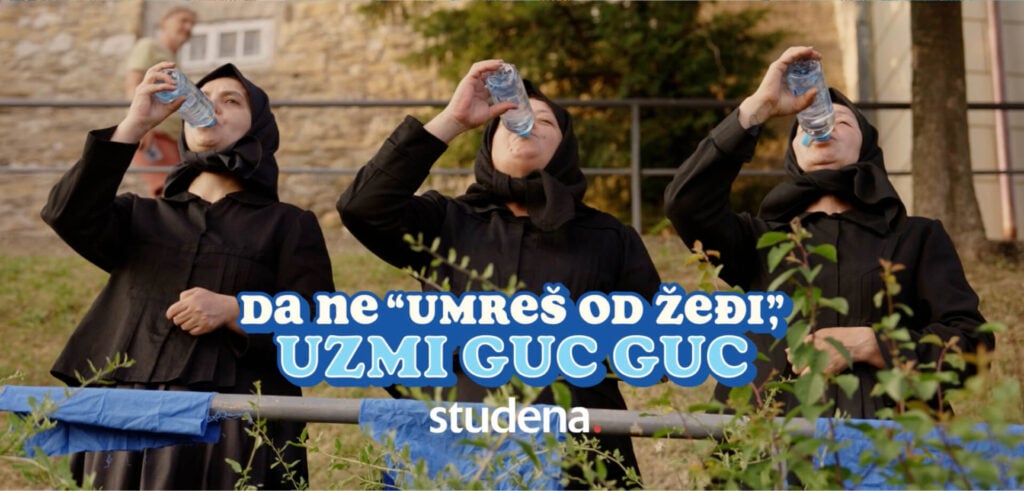
“I’m dying of thirst” is one of those phrases we say without giving it much thought. We do not use it to describe a real danger, but simply to say that, at that moment, we would give quite a lot for a glass of water. Studena and Imago Ogilvy decided to take this everyday hyperbole literally and turn it into a campaign.
Among the gold awards won at this year’s Days of Communication, The Last GUC GUC stood out with two golds at BalCannes, in the Non-Alcoholic Beverages and Best Online Video categories, and three golds at IdejaX, in the Non-Alcoholic Beverages, Best Online Video and Best Social Media Idea categories.
The problem was not to find a new reason why people should drink water. Health, purity, natural origin, refreshment and the importance of hydration are already deeply embedded in the communication of almost every brand in the category. Through the GUC GUC platform, Studena was already talking about hydration, so the real challenge was how to make something the audience had long known worth paying attention to again.
If someone is really “dying of thirst,” then someone surely has to mourn them. That “simple” logic led the campaign to mourners, and Studena into a communication space that water almost never occupies.
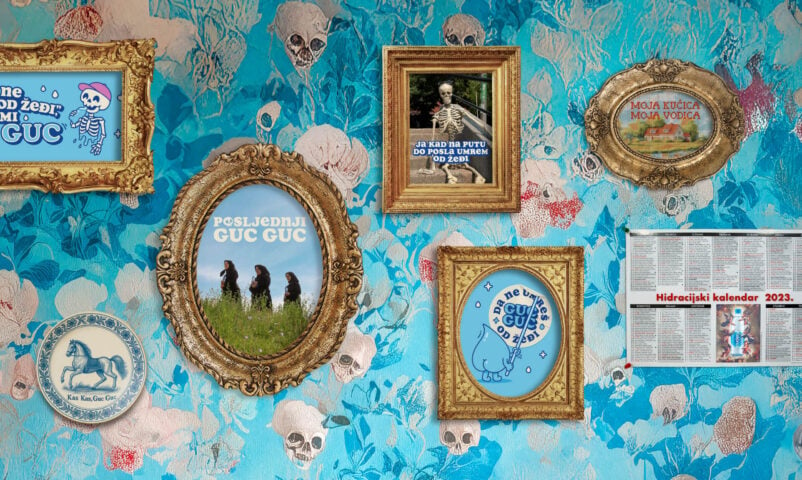
One message is no longer enough
Studena had a rather difficult communication task within the category. Hydration itself cannot be the exclusive advantage of a single water brand. It is a benefit shared by the entire category. Differentiation therefore had to come from the way the brand would talk about that benefit.
GUC GUC had already established a communication framework in which hydration is discussed more directly, simply and with more boldness than is usually expected in the water category. The next campaign therefore could not end with yet another reminder that we need to drink enough water. The agency and the client were looking for a way to turn a familiar message around so that the audience would notice it again.
In the phrase “I’m dying of thirst,” the team recognised something much more useful for creative development. The phrase is widely understood, we use it almost automatically and most often as an exaggeration. Its literal meaning, however, is no longer harmless, because dehydration can seriously endanger health.
The campaign brought those two meanings together. The audience did not need another lesson about hydration, but a reason to notice a familiar message again. Studena therefore decided to symbolically “mourn” all those who had died of thirst and, in doing so, develop the Don’t Die of Thirst platform, followed by The Last GUC GUC.
From one phrase to three mourners
The creative process can almost be followed as a sequence of questions. What happens if we stop treating the phrase “I’m dying of thirst” as a metaphor? If someone has actually died, who mourns them?
The answer was the mourners.
As a traditional symbol of mourning, they already carry an emotional code that does not require much explanation. At the same time, they are specific enough to our region to give the campaign a local character and a visual identity that would be difficult to replace with any generic character.
The three protagonists mourn the dehydrated through verses about completely ordinary moments in which people simply forget to drink water.
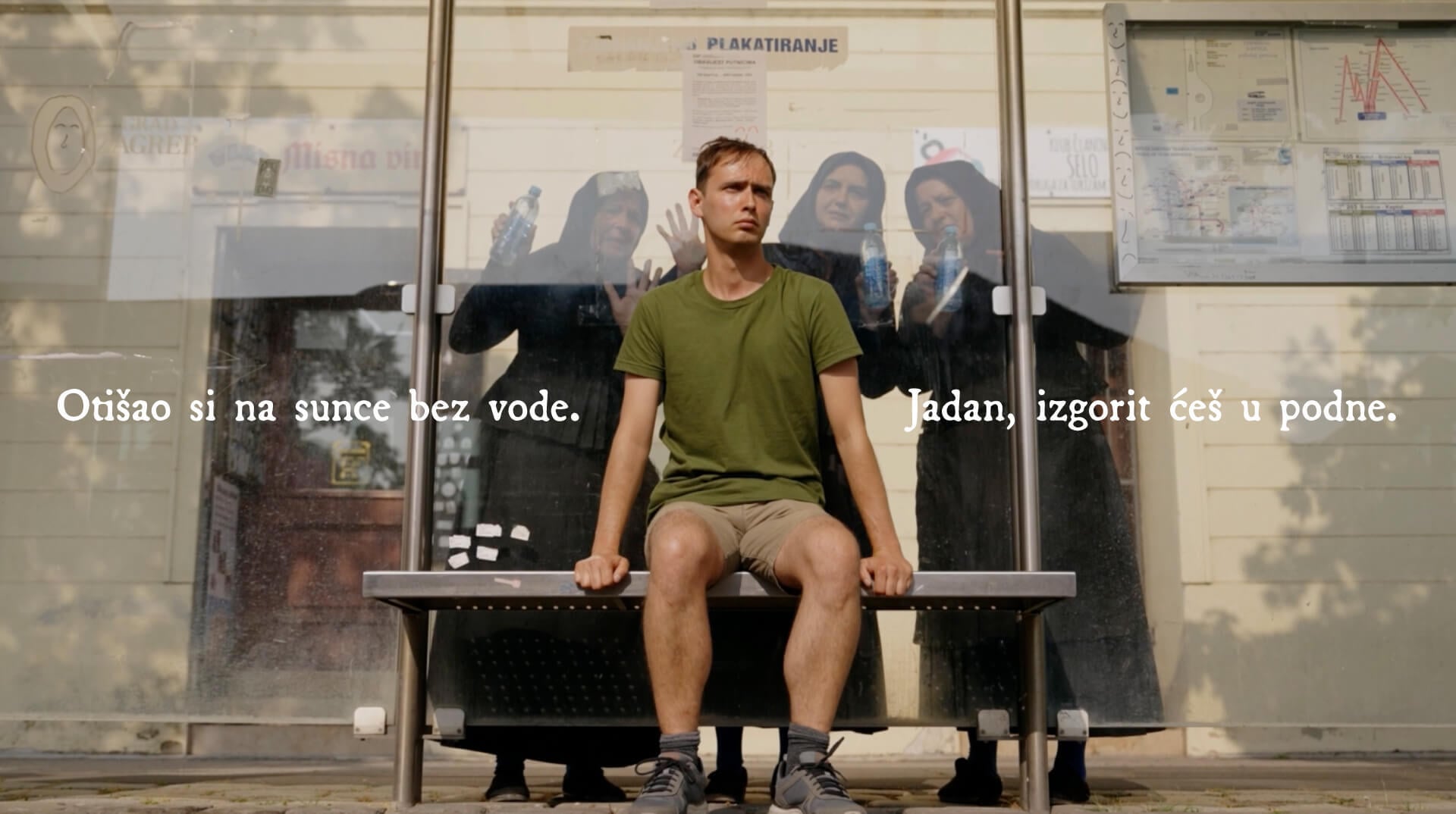
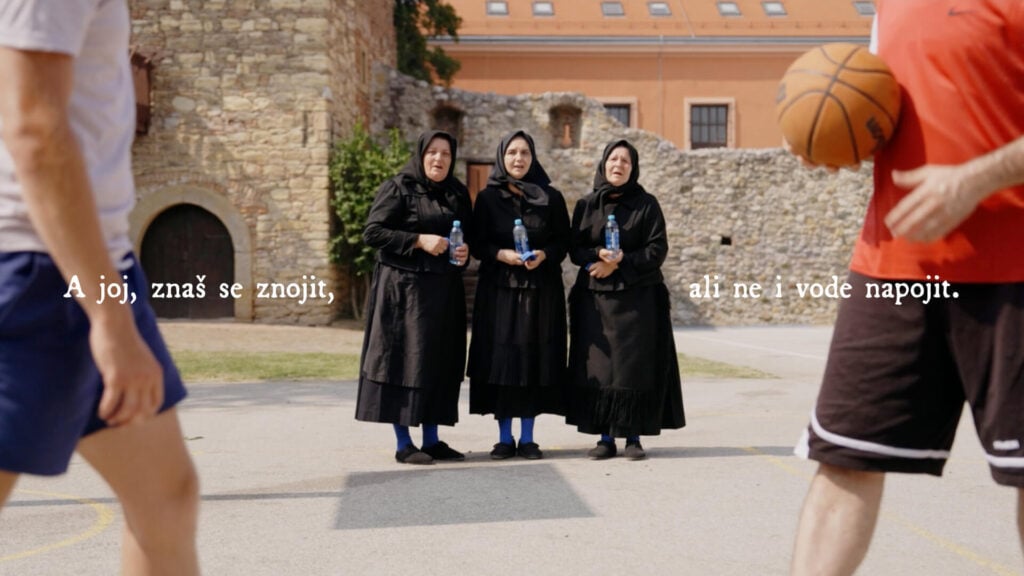
One detail was crucial to the tone of the campaign: the mourners could not become a parody of themselves. Their performance remained completely serious. They do not know they are funny and they are not trying to be funny. The humour comes from the contrast between their ceremonial seriousness and the banality of the reasons why someone ended up thirsty.
Had the protagonists winked at the audience or knowingly played for comedy, the entire idea could easily have slipped into a sketch. This way, the contrast could carry the humour, while the characters remained consistent with the world the campaign had built.
Black humour requires a fairly precise boundary
Connecting a water brand with death, mourning and mourners is not particularly safe creative territory. The problem was not only being brave enough to enter it, but knowing how far to go. The campaign had to be funny, but not tasteless; provocative, but not unclear. The cultural code had to remain locally recognisable, while the story itself had to be simple enough to be understood even by an audience unfamiliar with the tradition of mourners.
Even more important was maintaining the connection with the product. If the audience remembered only three unusual women and the black humour, but not the message about hydration, the creative execution would have defeated its own purpose.
That is why the construction is not complicated. There is no need to know the history or customs associated with mourners to understand the basic situation: someone has “died” of thirst, they have come to mourn them, and Studena suggests a much simpler solution.
The local cultural code thus gives the campaign character, but does not carry the entire burden of understanding it.
One good joke is not yet a campaign
The Last GUC GUC was not developed as a single spot that would later be shortened, cut up and distributed across channels. The campaign was set up as a digital-first system in which different formats had different tasks.
The two-minute central video established the world of the campaign, its characters and its dramaturgy. In it, the mourners mourn the dehydrated across several situations, while the longer format leaves enough room to establish their tone and the logic of the entire idea.
Shorter digital formats for TikTok and YouTube Shorts took parts of that world that could work at a much faster pace. Social media opened up another level of the story: the audience no longer had to remain only an observer.
Through the activation, followers received personalised, individually named recorded mourning performances. Community management, responses and reply posts allowed the mourners to react to people and the original joke to continue developing through their comments and participation.
This shows the difference between distributing a single idea and actually developing it across channels. The central video built the story. Short formats captured attention. Social media turned the audience into participants. Personalised mourning performances used the campaign’s own logic to produce new content.
DOOH, television and radio increased reach and recognition, while PR and media support expanded the story around the unconventional creative approach.
Risk is not approved only at the final meeting
The campaign grew out of the long-term collaboration between Studena and Imago Ogilvy, and that context explains how the idea with the mourners was able to survive the journey from the first presentation to execution.
The first GUC GUC campaign had already moved away from category conventions and opened up space for positioning Studena as a challenger brand. The Last GUC GUC was therefore not a complete shift in communication, but a more radical continuation of the direction that the client and agency had already been building together.
Imago Ogilvy led the strategic and creative development, from the initial insight and shaping of the idea to the script, production, digital formats, social media and community management. Studena’s team defined the business and communication objectives and brought knowledge of the brand, category, market and consumers into the process. At the same time, the client did not wait for the final presentation to say “yes” or “no.” The Studena team participated in the development of the idea, tone and execution, while previous campaigns had already shown how far the brand wanted and was able to go.
This is particularly important with an idea that could very easily be “made safer” through a series of small compromises. The mourners could have become less serious, the black humour milder, the mourning less direct. In the end, a recognisable concept would have remained, but probably without the reason it was interesting in the first place.
In this case, trust between the client and the agency was not an addition to the creative process. It was one of the conditions that allowed the final campaign to retain what had made it risky in the first place.
When attention reaches business indicators
The campaign was aimed at consumers aged 18 to 45, with a particular focus on the 18-to-30 segment.
Across Facebook, Instagram, TikTok, YouTube and the Google Display Network, it generated 42,976,009 impressions, 9.65% above the set KPI. Video content collected 26,858,910 views, exceeding the KPI by 171.29%, while 24,437,225 engagements were recorded, 321.33% above the target.
Facebook and Instagram reached 75% of the target group, or 1,746,892 users, while the number of Studena’s TikTok followers increased by 65%.
An even more important part of the results lies beyond the media indicators. Brand preference increased from 11 to 19, while the set target was 15. Sales increased by 12%, and market share by one percentage point.
These figures give broader meaning to the creative approach. The Last GUC GUC could have remained a campaign people remembered because of three mourners and the unexpected encounter between water and black humour. The results, however, show that the attention also translated into metrics that matter to the brand itself.
Studena did not try to find a functional benefit that its competitors did not have. It took hydration, one of the most basic and most frequently repeated messages in the entire category, and changed the way the audience hears it.
And the journey from “you need to drink enough water” to three mourners perhaps best shows why a creative insight does not always have to reveal something no one knew before. Sometimes it is enough to notice something we all already say and be the first to take it seriously.

