

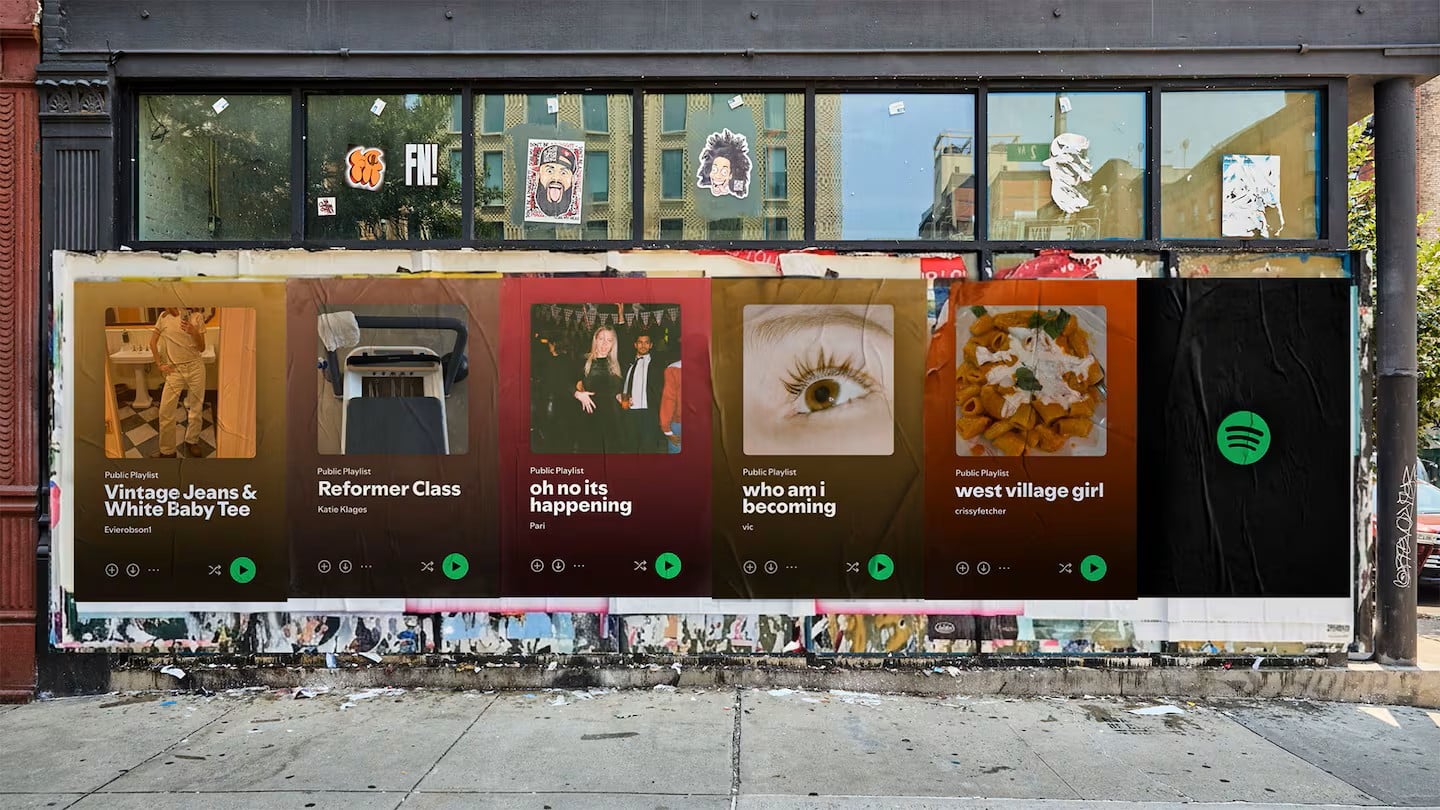
If a billboard asking Which one of you has a boat? appears in Miami, it might look like a perfectly reasonable message for a city where having a boat is not an unusual part of weekend plans. The difference is that no one at Spotify or its agency came up with it as an advertising slogan. It is the name of a real user’s playlist.
That simple reversal of roles is the basis of Playlist It, a new outdoor campaign developed for Spotify by Uncommon New York. Instead of turning user behavior into statistics, the platform took what listeners had already written for themselves and gave those lines a much bigger space, from billboards to posters on the streets of New York, Los Angeles and Miami.
The place where each title appears is not simply a media placement either. It completes the joke. In Los Angeles, a playlist called I refuse to take accountability so I blame it on the 405 appeared with a reference that any driver stuck on the famous 405 freeway understands very well. In other executions, individual titles were placed next to one another so that together they took on a new meaning.
The campaign actually began several months before its broader rollout. When the New York Knicks returned to the finals after 27 years, Spotify and Uncommon New York launched outdoor work that connected fans’ long wait with their playlists. That first appearance established the principle now being extended across three cities: find something a user has already said through music and place it somewhere the city will understand why it is funny, frustrating or familiar.
Behind the campaign is also a shift in the way younger audiences use playlists. They are no longer simply practical collections of songs for working out, driving or going out. Their titles can be a comment on a breakup, an attempt to boost confidence before a job interview, an inside joke or a small note about a mood that perhaps only the person who wrote it understands.
This is precisely where Uncommon New York creative director Sam Shepherd sees the value of the material the campaign received from users. For Gen Z, creating playlists has become one of the natural ways of expressing themselves, so the idea was to bring those personal moments from the app back into physical space and connect them with places and situations shared by a wider group of people.
Playlist It therefore recalls one of the most recognizable principles of Spotify’s advertising, but uses it differently. Wrapped draws stories about users from listening data. Here, users already arrive with ready-made titles. All that remains for the brand is to find the street, neighborhood or freeway where one private sentence will suddenly sound as though it was written for the entire city.

