


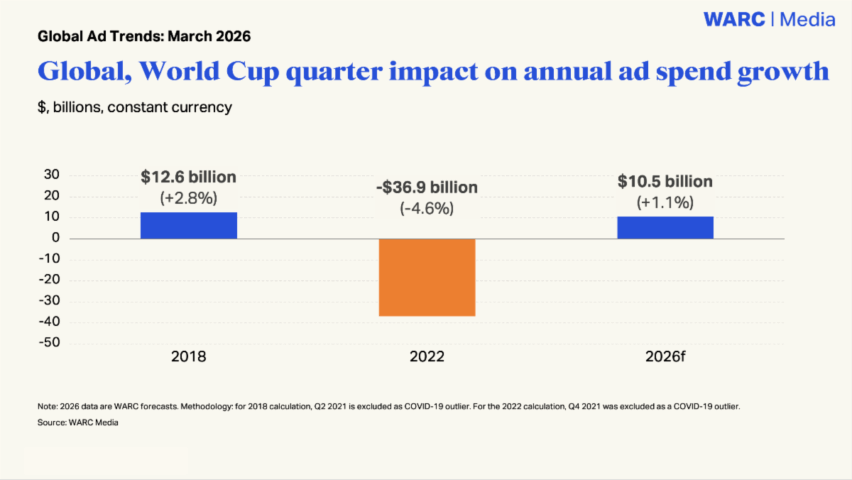
The 2026 FIFA World Cup is set to become the largest tournament in the competition’s history, spanning Canada, Mexico and the United States with an expanded number of matches and a truly global footprint. According to the latest WARC Media Global Ad Trends report, the event is expected to inject around $10.5 billion into the global advertising market. Yet despite its scale and cultural relevance, its direct impact on advertising growth is becoming less pronounced.
While the tournament will still inject billions into the market, its impact is more modest compared to previous editions. Earlier World Cups delivered stronger growth, while current projections suggest that advertising performance during tournament years is increasingly shaped by broader economic conditions rather than the event itself. Even in host markets, the uplift remains steady but not exceptional.
At the same time, audience behaviour continues to shift. Although global reach remains massive, linear TV audiences are declining as viewers move toward digital and multiplatform consumption. This trend is expected to intensify in 2026, further fragmenting attention across platforms.
For brands, this means the World Cup is no longer defined solely by live match broadcasts. Increasingly, value lies in the wider ecosystem of content and conversation surrounding the games. Social platforms, creator-led formats and on-demand content are becoming key touchpoints, allowing advertisers to engage audiences beyond traditional rights-based media.
Although major tournaments still drive strong revenues for channels like TV and out-of-home, these gains often reflect a redistribution of existing budgets rather than true market expansion. At the same time, scheduling dynamics in many regions may limit peak-time viewing, but open up opportunities through highlights, social content and alternative formats.
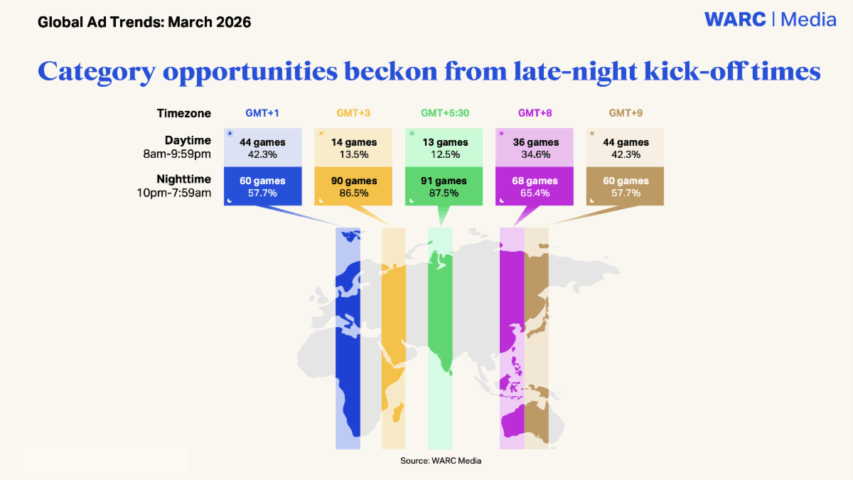
The tournament schedule also introduces new dynamics for advertisers. With many matches taking place outside peak viewing hours in Europe, Asia and the Middle East, traditional live broadcast opportunities may be constrained. However, this creates space for alternative formats such as highlights, commentary and social content, allowing brands to remain relevant even without direct rights access. It also opens up new possibilities for categories affected by advertising restrictions in certain markets, particularly in late-night environments where regulatory limitations are less restrictive.
The findings highlight a structural shift in how global sporting events drive marketing value. The World Cup remains a high-impact cultural moment, but its commercial influence is becoming more fragmented, requiring brands to rethink how they engage audiences across an increasingly complex media landscape.

