

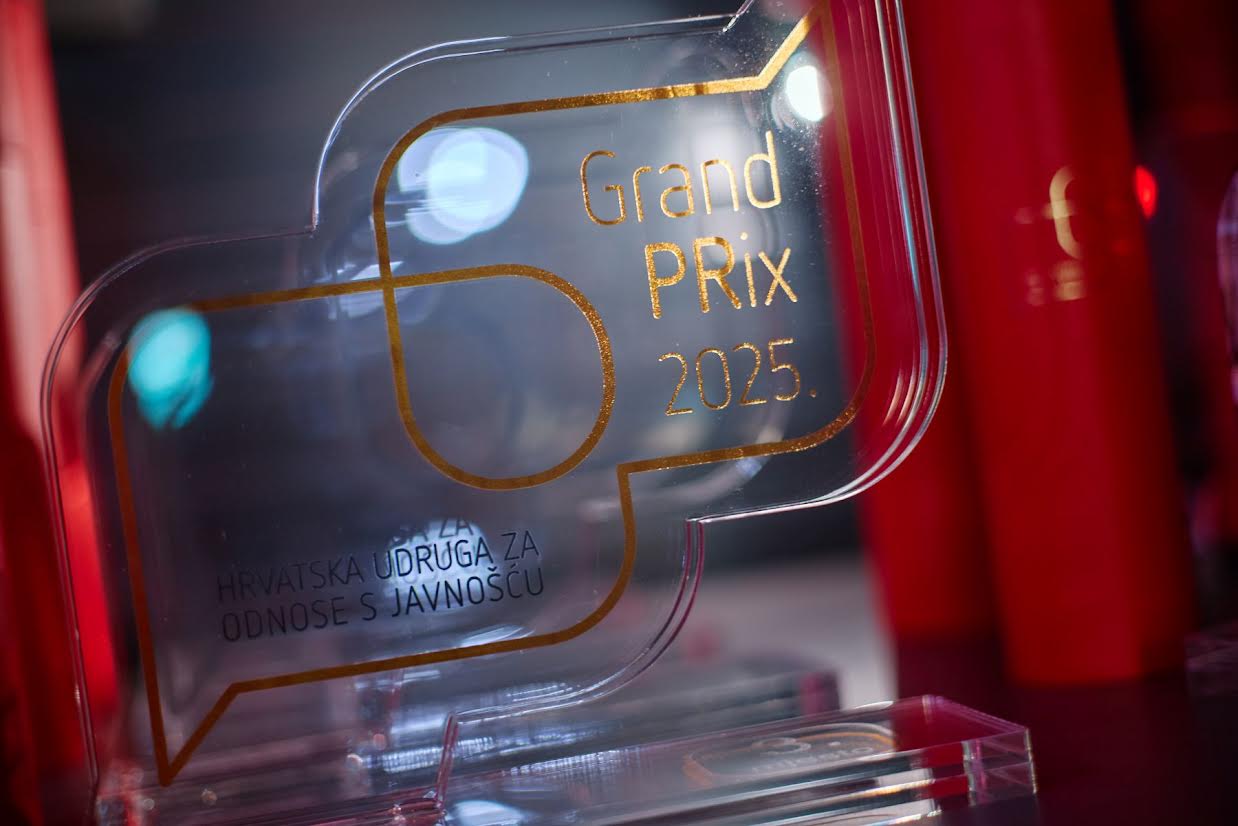
At a time when communication has never been faster, but also never more prone to error, the question of the quality of public discourse is once again coming into focus. It is within this context that Croatian Public Relations Association through this year’s Grand PRix, opens a broader discussion: who builds trust, and who actively undermines it.
These awards do not function merely as recognition or criticism of individuals – they act as a kind of industry benchmark. Because the way public figures communicate today directly shapes the perception of institutions, media, and society as a whole.
Communication as responsibility, not just a skill
The focus of the Communicator of the Year selection is not on the loudest voices, but on those who manage to balance clarity, responsibility, and impact. These are individuals who use communication as a tool for connection, not polarization – and who demonstrate that tone can be just as important as content.
Marijan Gubina, through his personal story and the film “260 dana”, brings communication back to its core function, dialogue. Instead of deepening divisions, he chooses a narrative of reconciliation and personal responsibility, particularly in his engagement with younger generations.
Vedrana Pribičević shows that expertise does not need to remain confined to academia. Her public appearances both simplify complex economic topics and open space for discussions around personal yet socially relevant issues such as mental health and online abuse.
A similar approach is taken by Ranko Rajović, who translates complex scientific concepts into everyday language. His work highlights that the true value of communication lies in its applicability – when audiences not only understand, but are able to act.
On the other hand, Severina Vučković demonstrates how popularity can become a platform for advocacy. Through her involvement in the initiative My Voice, My Choice, she steps beyond the boundaries of the entertainment industry and into the space of social and political discourse, consciously taking on reputational risk.
Where communication becomes the problem
Alongside examples of good practice, the Anti-Communication of the Year selection highlights a more uncomfortable, but equally important, side of the story: patterns that erode trust.
Dalibor Matanić was nominated for his communication in a crisis situation that required clarity and empathy. Instead, his public statements appeared fragmented and avoided responsibility, the exact opposite of what such moments demand.
In the case of Josip Dabro, the issue was not only the content, but also the way the situation was communicated. Following a scandal that led to his resignation, he announced his decision via social media, without clearly distancing himself from his actions. Subsequent statements, in which he attempted to downplay the situation, further reinforced the perception of avoiding responsibility and a lack of direct accountability.
The most extreme example comes from the case of Borivoj Vincetić, where communication crosses into the realm of disinformation. The spread of false information, particularly in a digital environment where speed outpaces verification, demonstrates how quickly communication can produce real societal consequences.
More than awards: a question of standards
What makes this selection relevant for the wider industry is that it speaks not only about individuals, but about patterns. Because in an era where everyone can communicate, the difference is no longer who has a voice – but how it is used.
Through this, the Grand PRix does more than assign recognition. It raises a question that may be more important than the winners themselves: what kind of communication do we want to normalize – and what consequences are we willing to accept if we don’t.

