

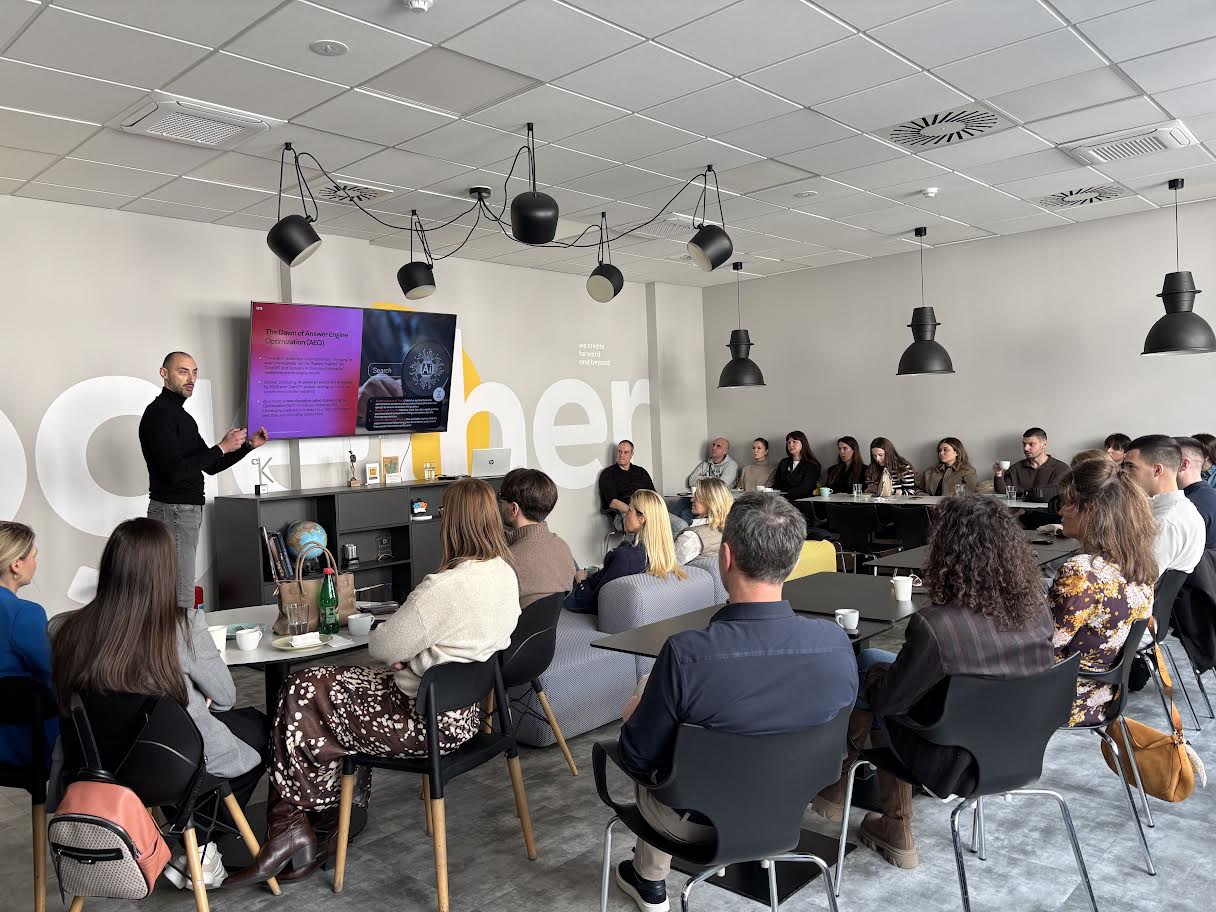
In a digital environment where trends no longer develop linearly, but emerge and disappear almost at the pace of scrolling, brands are entering a phase of deep transformation. The rules of visibility, influence and reputation are being redefined under the strong impact of artificial intelligence, and the analysis prepared by UM Belgrade (a member of AMA Group) points to key shifts that will shape communication strategies in the long term.
One of the most significant changes relates to the evolution of search. Traditional models such as Google Search are increasingly giving way to so-called answer engine environments, where users access information directly through AI tools and LLM systems such as ChatGPT and Claude. In this context, SEO is evolving into AEO (Answer Engine Optimization), an approach that implies actively managing how AI systems interpret and present brands.
This transformation has direct implications for reputation as well. AI-generated content, including misinformation and manipulative formats, spreads faster than ever, while corrections often do not reach the same level of visibility. Reputation management therefore becomes a continuous process, requiring constant monitoring, adaptation and the building of credible sources within the AI ecosystem.
At the same time, the way influence is measured is also changing. The creator economy is moving away from popularity metrics and increasingly focusing on tangible contributions to business results. Creators are thus evolving into strategic partners, while brands gain clearer criteria for evaluating the value of collaborations.
Advances in the application of artificial intelligence are further accelerating the development of hyper-personalisation. Communication relies less on demographics and increasingly on understanding individual behaviours, interests and values. At the same time, audience expectations are rising, as people can more easily distinguish relevant content from generically automated messages.
Changes are also visible at the channel level. Social media are increasingly taking on the role of search engines, particularly among younger generations, positioning content as a key tool for visibility, not just engagement. In such an environment, being present across multiple platforms is no longer enough – what matters is consistent yet contextually adapted communication.
Video is further strengthening its dominance, but with a clear division of roles: short formats serve to capture attention, while longer content builds relationships and loyalty. At the same time, the industry is shifting from trend-jacking to actively shaping trends, where authenticity and originality become key differentiators.
Additional complexity comes from the rise of virtual influencers and AI-generated identities. While they offer control and scalability, their use raises questions of trust and authenticity, making them a strategic rather than a tactical decision.
In conclusion, the success of brands in the coming period will depend on their ability to connect technology, data and human understanding into a coherent system. Artificial intelligence is becoming an unavoidable partner, but the key difference still lies in the human ability to interpret context, culture and the values that shape the modern market.

