

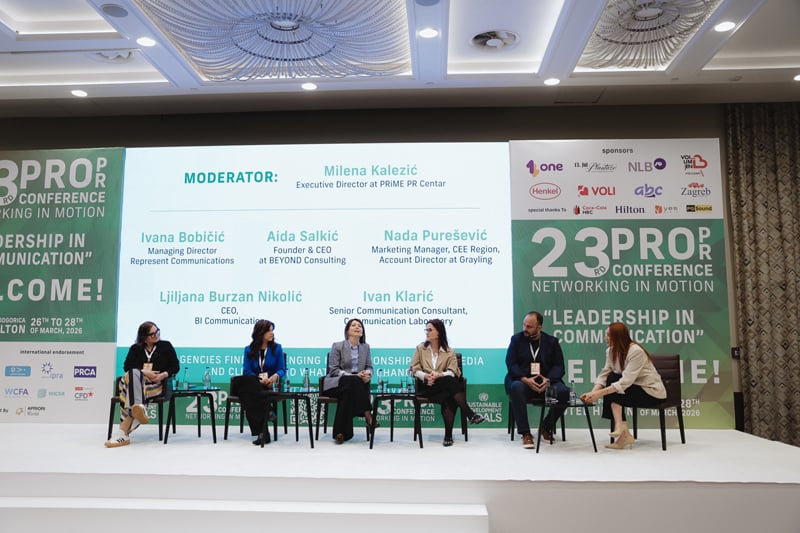
The PR industry today operates in a paradox: it has never been more important for business, yet at the same time it functions under conditions of reduced budgets, a fragmented media landscape, and increasingly demanding clients. It was precisely this gap that was in focus at the panel held during the 23rd PRO PR Conference.
In the opening, Michael Schröder clearly set the tone of the discussion – communication is no longer about messages, but about relationships. Instead of generic press releases, the focus must shift towards context, understanding, and dialogue with the media, while client relationships require moving beyond a purely transactional model and returning to long-term trust building.
That the industry is under real pressure was also confirmed by Milena Kalezić, panel moderator and CEO of PR Centar, who pointed to declining optimism and revenue stagnation, alongside additional challenges brought by AI transformation and the shifting of budgets to other industries. In such an environment, the market structure is also changing – agencies are consolidating, teams are shrinking, and clients are increasingly opting for more flexible models or developing in-house capabilities.
At the same time, changes in the media landscape further complicate the position of PR. As emphasized by Ivan Klarić (Communication Laboratory, Croatia), the boundary between editorial and paid content is becoming more visible, but also more important. While paid content is becoming the norm, editorial coverage still holds the greatest credibility, which brings PR back to its core role – shaping the story, not just securing its placement.
This need for a deeper role is increasingly positioning PR closer to decision-making. Ivana Bobičić (Represent Communications, Montenegro) highlights that communications now have “a seat at the table,” but that this also comes with greater responsibility – especially in an environment where organic media space is declining and paid content is becoming the dominant model.
On the other hand, Alda Salkić (BEYOND Consulting, Bosnia and Herzegovina) points out that these changes are not only a challenge but also an opportunity – provided the industry clearly communicates its value. She particularly emphasizes the need to educate clients, as well as the risks of misinterpreting AI tools, which without proper context can create unrealistic expectations regarding the value and scope of PR services.
That the transformation is moving towards greater strategic relevance is also confirmed by Nada Purešević (Grayling, Serbia), who highlights the shift from tactical tasks to a role that directly impacts business results. Reputation, trust, and transparency are increasingly becoming measurable categories, further blurring the lines between PR, marketing, and business. “In such an environment, clients expect concrete results more than ever before. They want PR that delivers results, and that those results directly reflect on their business,” Purešević stated.
In this context, technology is emerging as a tool, but not a solution. As emphasized by Ljiljana Burzan Nikolić (BI Communication, Montenegro), artificial intelligence can enhance work, but it cannot replace knowledge, context, and judgment – precisely what is becoming the key differentiator in the industry. “It is important to surprise the client – to show that you have thought more and deeper. That is recognized and builds long-term relationships,” she noted.
All of this points to a deeper shift: PR is moving away from the role of a content distributor and increasingly taking on the function of a strategic advisor. In practice, this means earlier involvement in processes, greater responsibility for business outcomes, and the need to measure communication not only through outputs, but through real impact.
In a world where attention is limited and content is unlimited, the value of PR is no longer in the volume of coverage, but in the ability to build trust – and relationships that last longer than a single campaign.

