

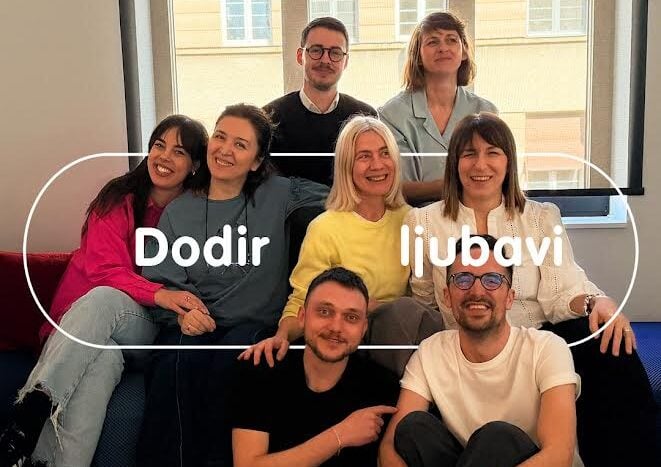
At a time when communication is increasingly chasing attention through formats, platforms and performance, few brands choose to pause and build a story around something that can neither be measured nor optimized. The new platform “Touch of Love,” created by Plazma and McCann Belgrade (a member of AMA Group), moves precisely in that direction – toward a fundamental human experience that precedes any form of communication.
The starting point is not the product, but the insight. Touch, as the first language we learn, as a signal of safety, belonging and closeness, becomes the central motif around which the entire platform is built. In a time when everyday life and attention are fragmented, the campaign attempts to return the focus to something elemental and universal.
Visually and narratively, the campaign unfolds through a series of intimate, almost slowed-down moments: hands finding each other, embraces, small spontaneous gestures that carry emotional weight. Instead of grand narratives or spectacle, the focus is on detail and atmosphere. The TV spot follows the same approach, through scenes of relationships. between parents and children, partners, friends, where closeness is communicated without the need for additional explanation.
Within this setup, Plazma does not appear as the central hero, but as a quiet companion to everyday rituals, something that is already part of those moments. In this way, the brand is positioned less as a product and more as a symbol of continuity and shared experience passed down through generations.
As Jana Savić Rastovac, Creative Director at McCann Belgrade, explains, the idea was to avoid distance and create a platform in which everyone can recognize themselves: “We wanted a campaign that is close to people, to the senses, to the subtle nuances of closeness. ‘Touch of Love’ speaks about everything that Plazma sets in motion and is organically a part of: warmth, trust and joy.”
What this platform attempts is a shift in focus from functional value to the emotional context in which the brand exists. Instead of answering the question of why to consume the product, the campaign tries to answer why those moments matter in the first place.
In a broader sense, this is another example of how brands from traditional categories are seeking space beyond the category itself – in this case, within the domain of human relationships. Whether such an approach will have long-term strength will depend on whether “Touch of Love” remains just a campaign or evolves into a consistent communication framework.
For now, Plazma chooses a quieter tone – and a reminder that the simplest things are often the hardest to communicate.

