

We all speak about adaptation as the only constant. But perhaps 2026 will not be a year of faster adaptation, but of clearer boundaries. Boundaries toward unreasonable demands. Boundaries toward safe, but faceless creativity. A boundary between technology that helps and an idea that must have madness and talent.
The industry often seems as if the democratization of tools has erased the difference between a professional and an amateur. As if everyone can do everything and no one needs anyone anymore. But that is not quite so. Technology can speed up processes; it cannot replace madness and talent. It cannot produce team chemistry. It cannot make the audience feel.
Perhaps that is why the real question for 2026 is simple: are we ready to make people cry? Not just to entertain or impress them, but to truly touch them. It is precisely through that lens that we look at the year behind New Moment, Agency of the Year in Serbia – a year in which strategic decisions about processes were made in parallel, boundaries toward clients were redefined, and campaigns were created that consciously choose character before safety.
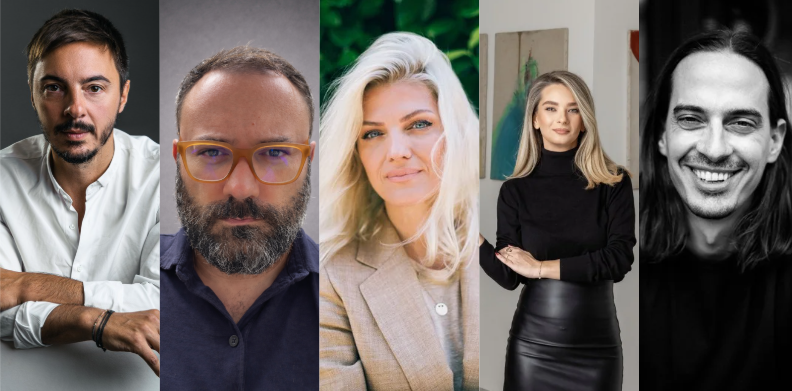
With Žarko Sakan – Managing Director, Đuro Radosavović – Creative Lead, Katarina Todosijević – Marketing & PR Director, Jasmina Nikolić – Regional Project Director SEE and Lazar Sakan – CEO, we open questions of decision-making speed, the relationship toward AI, authenticity in communication, regional collaboration and what it truly means today to be cheeky in an industry that increasingly chooses predictability.
Žarko Sakan, Managing Director (3 questions)
1. If you had to summarise 2025 in one strategic decision you would make again, and one you would make completely differently today – what would those two “plot twists” be?
We made a strategic decision to include a consulting firm in order to improve our business processes and prepare the company for the next 10 years. The only thing I regret is that we did not do it earlier.
All the strategic decisions we made, I wish we had made much faster. It seems to me that it is better to make a decision quickly and even make a mistake than to think for too long and not make a decision.
2. What forced your agency to grow up the most this year, and what made it play like a child again? High inflation and increased labor costs, along with growing client pressure, forced us to make difficult decisions. We had to start “measuring” the exact contribution of each team member, and that is very difficult in the creative industry. It is even harder for us because we say that when you enter New Moment you do not punch a card but your heart. Passion and dedication are virtues we value, alongside expertise and creativity, and that is hard to quantify. In addition, our work is a team game and all players contribute to the overall result.
We managed, with large, complex clients and everyday work that suffers a large number of changes, to create campaigns that brought us the title of Agency of the Year in Serbia. That is a sign that the sun cannot stay in the basement and that with positive energy and love for the profession all projects can shine in full glow.
3. If the Adriatic industry were a publicly traded company, what rating would you give it entering 2026? And why should investors (or should they not) hold its shares?
The Adriatic region is one economic space, but it is quite fragmented; we have countries in the EU and countries in a perpetual process of joining the EU. All markets are similar, yet very specific.
If I were an investor on the stock exchange, I would never invest in the Adriatic. There are many more profitable regions and easier territories for doing business.
However, I am not an investor; Adriatic is the home where I grew up and achieved everything so far. Therefore, I do not look at this region as an investment, but as a place where I was born, live and which is part of my identity.
Đuro Radosavović, Creative Lead (3 questions)
4. Which idea in 2025 made you stand up from the table and say “Okay, this is why I still do this job”?
I stood up and applauded the campaign “Bad Luka, nice shoes“ for Jordan sneakers, as after the premiere of a good film or play. At a time when everyone is playing it safe, it showed that there is a recipe for a fantastic campaign: a dose of self-irony, a pinch of humor, a lot of courage and tons of talent. And of course perfect timing as the icing on the cake!
A case study on how to connect the character of an influencer with the uniqueness of the product, in a way that looks unobtrusive, watchable and appealing. This is one of the campaigns moving toward a “short film“, which is clearly the future of advertising. Short films!
5. What was your biggest creative risk this year, and did it pay off in the way you expected… or in a way you could not have predicted?
We convinced the client to make a shift in communication, that in the time of AI our heroes should be real people, that farmers should be heard and seen without makeup and filters. Soil, sun, face and product. Everything raw, and the campaign told and executed “FIRST HAND“.
It sounded crazy, but it went through and succeeded. Metrics showed fantastic results, numerous awards arrived, Maxi Delhaize is Client of the Year at UEPS and New Moment Agency of the Year. To quote the informal slogan of the city of Austin: “Keep Austin weird“! There is no other way.
6. Which creative weakness does the industry in the region persistently conceal, and what would you do if someone appointed you to “expose” it during 2026?In the time of ChatGPT it seems that everyone can do everything and that no one needs anyone. But that is not quite so. For a campaign that will delight and be talked about, something is needed that ChatGPT still cannot output: madness and talent. When we show clients that we are crazier and more talented, only then will they trust us. We can do that if we believe in ourselves and if we truly love this job.
Boldness is concealed, boldness is restrained, and that is why campaigns mostly resemble one another, because everyone plays it safe. Maybe the solution is for every brief to begin with the sentence: “we want you to make people cry“. They can cry from laughter or from emotion. The difference is great, but tears do the job.
Katarina Todosijević, Marketing & PR Director
7. Which common assumption about consumers did you have to “break with a hammer” in 2025 because it was no longer true?
The assumption that attention is shorter than ever. For years the “three seconds“ rule has been repeated, but the truth is that attention has not disappeared; it has become more demanding and more selective.
Consumers are ready to watch long formats, to listen to a one-hour podcast, to follow a brand series, but only if it is relevant and authentic to them. The relevance and honesty of the message we convey is what matters, not its format and duration.
8. If you had to predict one psychological shift of the audience in 2026 that will most change communication, what is that shift, and why is it invisible until it has already happened?
Communication is beautiful precisely because it always brings something new, it adopts new forms the fastest and the speed at which it travels to end consumers. Perhaps its biggest shift in 2026 will be fatigue from hyperproduction and perfection.
The audience has for years been exposed to perfect, polished narratives and algorithmically optimized messages. A quiet need is slowly emerging for something slower, rawer and more real. That is a shift that is invisible because it does not happen overnight, but accumulates through micro-reactions, through increasingly frequent ignoring of “overproduced“ content.
The task of successful communication will be to become less perfect and more human and accessible.
Jasmina Nikolić, Regional Project Director SEE
9. Which new skill, habit or ritual in the team could you this year mark as “born in the Adriatic industry”, as something that exists nowhere else?
This year we institutionalized something that had long existed intuitively – forming project teams from the entire New Moment region exclusively according to knowledge, affinities and real expertise, not according to geography or hierarchy.
That is truly “born in the Adriatic industry“. We operate in markets that are small, fragmented, politically and socially layered, and not every market has enough of all the necessary expertise. And in serious work, mediocre expertise does not pass. If you are not truly relevant and genuinely interested in what you do – the audience, the market or the evaluator reads you in three seconds.
That is why we decided to breathe as a regional brain trust. For one project, a creative from Belgrade, a strategist from Ljubljana and a project manager from Tirana can work together – because that is the best combination, not the most practical one.
10. What is the most unexpected sentence you heard from a client this year, and how did it change your brief, campaign or relationship?
“We want a cheeky campaign.“
We had never received such a brief before. Not “innovative“, not “different“, not “disruptive“. Cheeky. And that one word changed everything.
We stopped thinking about how to be correct and started thinking about how to be brave. We stopped ironing out messages so as not to disturb anyone and started building a stance. Cheekiness, in our reading, did not mean irresponsibility – but confidence. Not noise, but intelligent provocation.
The energy in the room was different. Decisions were faster. When a client explicitly says they want character, not safety – that is serious trust capital.
That sentence changed the relationship as well: from “deliver us a solution“ to “let’s move the boundary together“. And we moved it – both creatively and commercially.
You do not get such briefs often. But when you do, you know you are in a true partnership.
Lazar Sakan, CEO
11. If someone offered you to start 2026 with one single “act of courage”, professional, creative or human, that would completely take you out of your comfort zone and push the industry one step forward… which act would you choose and why that one?
- Leading an agency today is in itself an act of courage. As change has become the only constant in today’s time, being ready to adapt and to make new and difficult decisions that absolutely push you out of your comfort zone is, among other things, courage.
In that sense, I have never had a problem with courage as such, nor have I ever thought about what I would do if I had a magic wand for courage. What I would like at the level of the entire industry and all my colleagues is for boundaries to be set more often toward unreasonable, inappropriate and above all inhumane client demands, and that in such cases NO is always said.

