

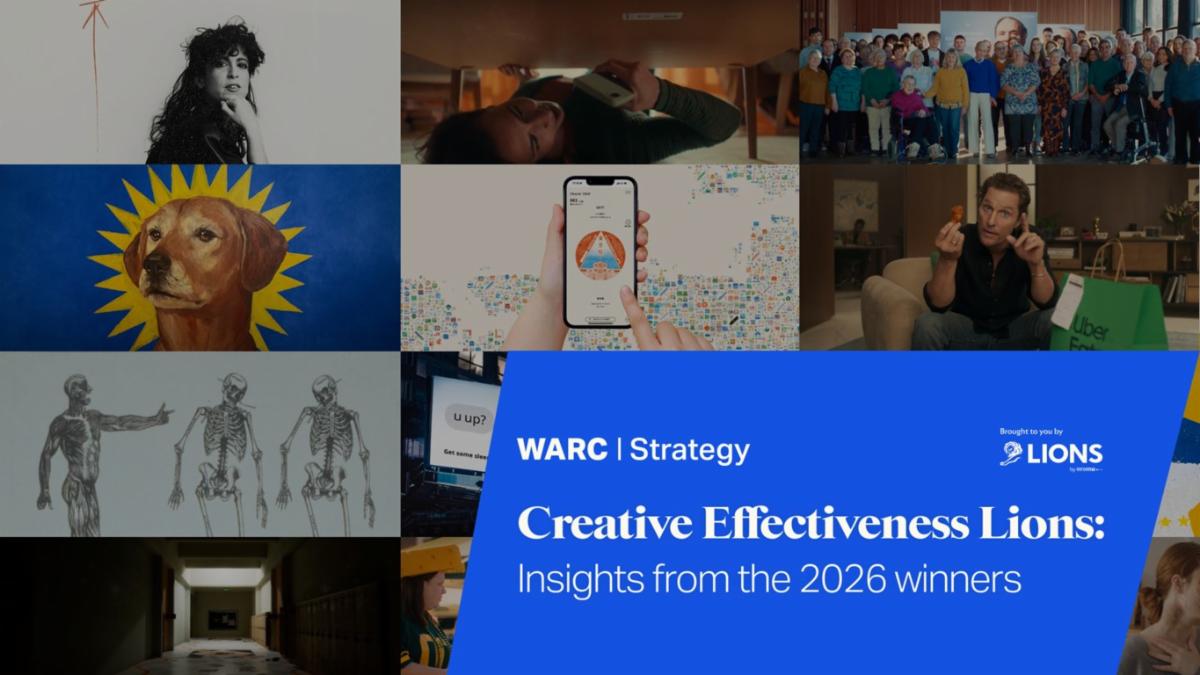
WARC published the report Creative Effectiveness Lions – Insights from the 2026 Winners on 12 August, focusing on the campaigns awarded at this year’s Cannes Creative Effectiveness Lions. Among the work that achieved measurable and long-term business results, the organisation identified three common characteristics: the active use of cultural insights, audience involvement in the brand experience, and ideas designed according to the logic of the platform and the community they address.
The report is based on the submitted work and WARC’s access to the jury deliberations. In addition to an overview of the winning strategies, it provides recommendations for advertisers, agencies and media owners, and explains what the jury was looking for beyond an attractive creative execution.
“This year’s winning campaigns in the Creative Effectiveness category offer valuable insights for marketers, demonstrating how creative excellence can address genuine business and social issues while delivering meaningful growth,” said John Bizzell, Content Lead at WARC.
Cultural insight has value only when it drives change
The report’s first theme is summarised in the recommendation that brands should not merely reflect cultural rules but rewrite them. A superficial recognition of trends is not enough for a brand to find room for growth. WARC views cultural analysis as a business tool that can uncover new needs, change the offering and create a relevant point of difference from competitors.
The category’s highest honour went to Three Words, a campaign developed by Publicis France for AXA. The three words in the title refer to the phrase “and domestic violence”, which was added to home insurance contracts. The change enabled victims of domestic violence in France to relocate in an emergency and demonstrated how a cultural and social insight can influence the product itself instead of remaining merely a topic of communication.
Gold also went to Caramelo, a campaign by AlmapBBDO São Paulo for Pedigree. The brand reconsidered the meaning of the word pedigree and directed attention towards Brazil’s mixed-breed dogs, particularly the culturally significant Caramelo. The campaign encouraged their adoption while also expanding the market the brand addresses.
The brand is no longer seeking only the audience’s attention
The second pattern among the awarded campaigns concerns transforming existing brand elements into tools that people can use, explore or verify. Such experiences do not keep the audience in the role of an observer. Data, direct participation and a meaningful reward system can give people a reason to get involved while helping the brand build credibility.
Vaseline Verified, for which Ogilvy Singapore won Silver, was created in response to advice about using Vaseline that was spreading across social media. The brand collaborated with creators to test viral recommendations, correct inaccurate information and help consumers use the product safely.
IKEA took a different approach in Portugal. Hidden Tags, a campaign by Uzina Lisbon, invited customers to find hidden labels showing the production dates of old pieces of furniture. The years recorded on the products became proof of their durability, while the search allowed people to verify the brand’s promise themselves.
Creators and platforms become part of the idea itself
The report’s third theme distinguishes strategic partnerships from collaborations in which a creator simply receives a finished message to publish at the end of the process. According to WARC, greater impact is achieved when the creator adds value to the idea and the campaign uses behaviours and features specific to the platform. This allows it to continue living within the community after media investment has ended.
Silver-winning campaign Football is for Food, created by Special US for Uber Eats, connected the NFL sponsorship with specific opportunities to order food during games. Instead of merely maintaining a presence alongside the sport, the platform embedded its service into a habit that already accompanies watching American football.
Canadian agency Rethink won Bronze for U Up?, a campaign for IKEA. A message familiar from late-night digital communication was used to start a conversation with people who could not sleep, while different touchpoints directed them towards purchasing a mattress.
Jury President Bertille Toledano, CEO of BETC and Havas Creative Middle East and President of Havas Creative Network, explained that priority was given to campaigns whose impact could be seen in the lives of real people. In doing so, the jury relied on the Creative Effectiveness Ladder and looked for work with a clear cultural vision and an understandable brand position.
The way results are demonstrated is also important for future entries. Bizzell noted that the jury discussed sources, metrics and cultural context extensively. Business impact must be supported by credible data, while the significance of the insight must be explained to an international jury that may not be familiar with the local culture or category.

