

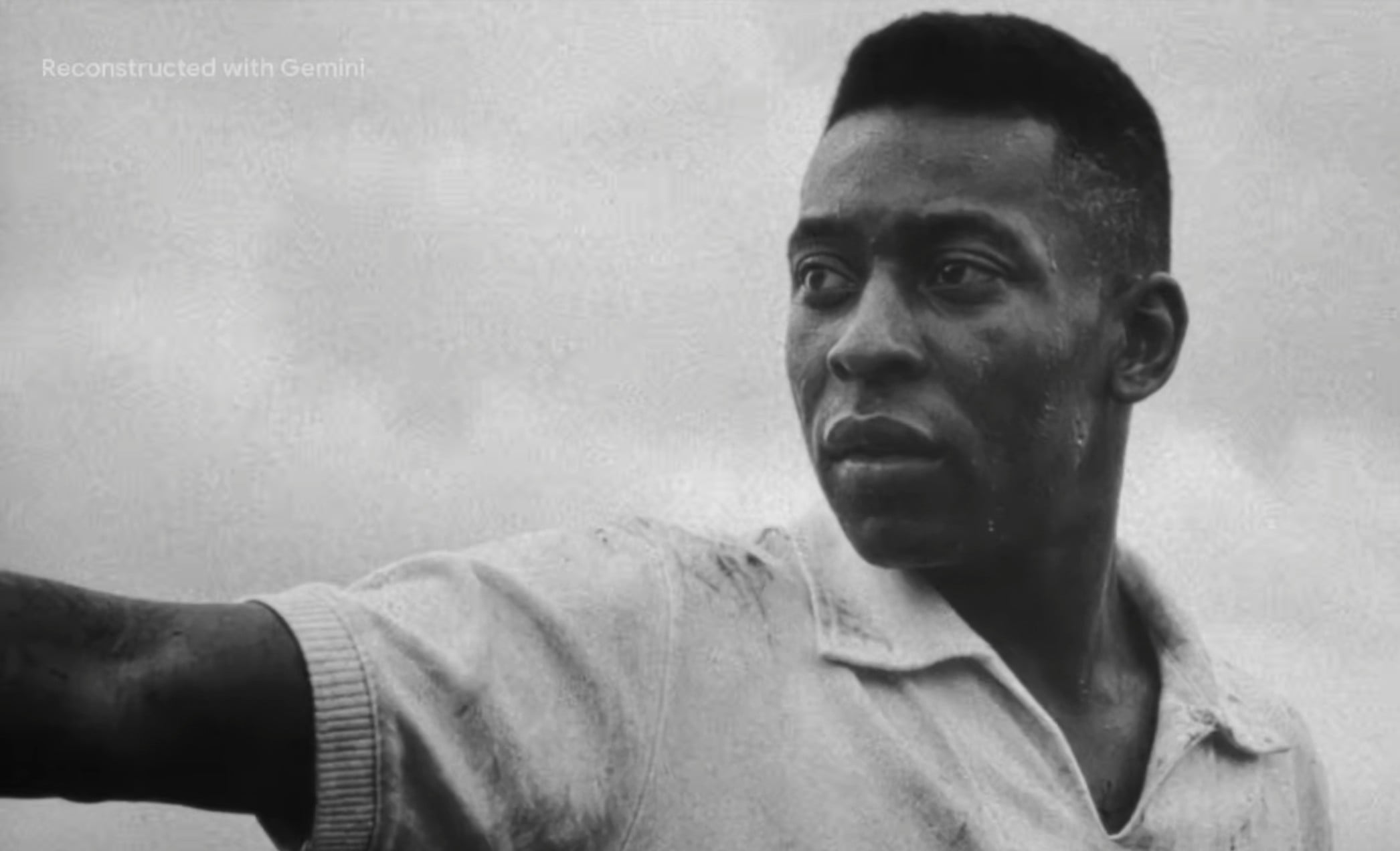
There was no recording of the goal that Pelé considered the most beautiful of his career to confirm what spectators had recounted for decades. What remained were newspaper reports, photographs, movement diagrams and the memories of people who were at Rua Javari Stadium in São Paulo on 2 August 1959.
Google DeepMind and Pelé Brand have now turned those fragments into the mini-documentary The Most Beautiful Goal Never Seen. The film was released on 14 July and follows the reconstruction of the famous Gol da Rua Javari, which Pelé scored while playing for Santos against Juventus. According to descriptions of the move, he flicked the ball over opposing players and the goalkeeper three times before sending it into the net without allowing it to touch the ground.
The reconstruction was not conceived as a free visual interpretation of the event. Pelé’s family, historians, sports journalists, footballers and eyewitnesses participated in the project, while archival photographs, stadium plans, family albums and newspaper reports from the period were used to verify the appearance of the pitch, equipment, crowd and the move itself. The team led by historian Anita Lucchesi collected almost 2,000 historical records and more than 3,600 photographs.
Part of the material was first filmed on the original pitch at Rua Javari Stadium. Contemporary footballers performed the reconstructed movements in uniforms from the period and with a heavy leather ball, after which the footage was processed using the Veo, Gemini Omni and Nano Banana Pro models.
Movement presented a particular challenge. Generative models can produce a convincing image, but a complex football move must follow body weight, the trajectory of the ball and the rhythm of a real player. Google DeepMind therefore used the Performance Control system, based on the Veo 3 model, which transformed the movements of stunt players into a three-dimensional foundation for the generated video. The players and the stadium were processed separately, allowing the team to adjust Pelé’s appearance, the number ten shirt and the historical setting without changing the choreography itself.
The final film combines AI-generated scenes with traditional visual effects. Traditional post-production was used to process the ball, the image and the film grain, while the final material was transferred onto film stock to bring its appearance closer to footage from the 1950s.
The project was created in collaboration with NR Sports, the company that manages the Pelé brand and legacy. His family served as guardians of authenticity throughout the process, ensuring that the reconstruction would not become a new version of the event, but an attempt to portray as faithfully as possible what the camera failed to capture in 1959.
The Most Beautiful Goal Never Seen is currently available on Google’s YouTube channel, while the reconstruction is also on display at the Pelé Museum in Santos. The project therefore continues beyond the moment of its launch as part of an exhibition dedicated to the footballer’s career and legacy.

