

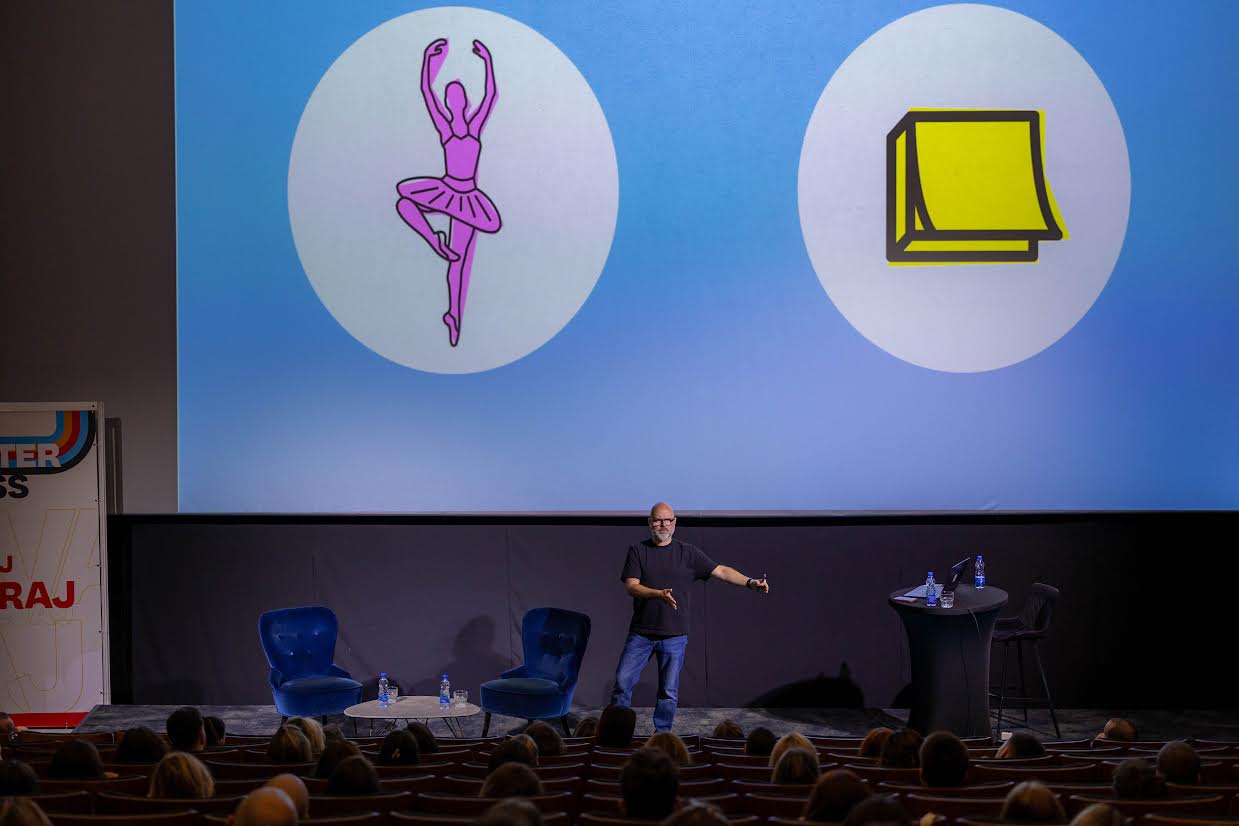
Generative artificial intelligence can produce dozens of ideas in a matter of seconds. Identifying the one that is truly worthwhile is much more difficult. What happens to our judgment when we become accustomed to technology suggesting solutions, and how willing are we to question what it offers us? These questions were at the heart of the first UEPS Masterclass, held on October 20 at the MTS Hall in Belgrade, under the title Think with AI. Not Like AI.
Organized by the Serbian Association for Market Communications (UEPS), the event brought together nearly 200 participants from agencies, marketing teams, IT companies, startups, and product development teams, as well as a large number of students. The association’s president, Marija Matić, and vice president, Jelena Brajović Dobrijević, announced their intention to establish the Masterclass as a regular educational event.
The keynote speaker, British creative thinking and innovation expert Dave Birss, explored how generative artificial intelligence can expand the creative process rather than reduce it to a series of predictable answers. At the heart of his approach is a simple distinction: using technology to explore possibilities is not the same as allowing it to make decisions for us.
Birss warns of the danger of creating an “ocean of mediocrity,” a situation in which excessive reliance on generative tools leads to similar ideas and the repetition of familiar patterns. His human-first approach is based on the belief that human curiosity, the ability to question assumptions, and a willingness to think differently remain essential to the quality of creative work.
During the lecture and practical workshop, he demonstrated how participants could guide AI tools more precisely, explore different directions of thinking, and evaluate which ideas have real value. The emphasis was on methods that can also be applied in the everyday work of creative and business teams.
Birss is the author of Iconic Advantage, How to Get to Great Ideas, A User Guide to the Creative Mind and Friction. Through educational courses on LinkedIn Learning, he has taught more than 1.5 million professionals worldwide about the creative and strategic use of generative artificial intelligence.
Boris Šurija on the Psychology of Accepting AI-Generated Answers
A different perspective was offered by Boris Šurija, a Croatian behavioral psychologist and entrepreneur who has spent more than 15 years working in applied psychology, behavioral economics, and the prediction of human behavior.
While Birss focused on preserving creative independence, Šurija examined the psychological mechanisms that influence how people use artificial intelligence. His lecture addressed cognitive biases and the ways in which AI can steer our thinking toward answers that appear convincing but may not necessarily be the most useful.
Šurija is currently researching the psychology of artificial intelligence, particularly the mapping of cognitive biases in large language models (LLMs). This field is becoming increasingly important as generative tools become part of analysis, planning, and business decision-making processes.
The Creative Process Still Requires Human Judgment
The common thread running through both lectures was the need to distinguish between the speed at which technology produces answers and the quality of the decisions people make based on those answers.
For the marketing and communications industry, where generating, selecting, and evaluating ideas are part of everyday work, this distinction has particular practical significance. AI can help explore different possibilities, but choosing the right creative direction still requires an understanding of the problem, the context, and the audience.
The first UEPS Masterclass thus opened a discussion that goes beyond knowing how to use individual tools: how to integrate them into everyday work while preserving the ability to think independently and exercise professional judgment.

